All-on-4 Dental Implants Explained: Cost, Process, and Trade-offs
All-on-4 is a full-arch implant system: four implants per jaw support an entire arch of fixed, non-removable teeth. It typically costs $15,000–$30,000 per arch in the US in 2026 ($28,000–$55,000 for both), and many patients leave surgery day with temporary teeth. The clever engineering is in the back implants, which are angled to use available bone and avoid grafting. The trade-offs: it’s still major surgery, the final teeth take months, and not every mouth qualifies.
This isn’t a product pitch — All-on-4 is a technique, offered by thousands of independent clinics as well as branded centers, with meaningful variation in materials and pricing. Here’s how it actually works.
Key takeaways
- Four implants per arch (two straight, two angled) support a full fixed bridge — $15,000–$30,000 per arch.
- Angled rear implants often avoid bone grafting and sinus lifts — the system’s signature advantage.
- Timeline is typically 4–8 months: surgery day with temporaries, then months of healing before final teeth.
- All-on-6 adds implants for redundancy; more isn’t automatically better — placement matters more than count.
How It Works: The Engineering in Plain English
A full upper or lower arch has 10–14 teeth. Replacing each with its own implant would mean 10+ surgeries’ worth of posts, at $50,000–$90,000 for both arches. All-on-4 asks a different question: what’s the minimum number of well-placed implants that can carry a full arch?
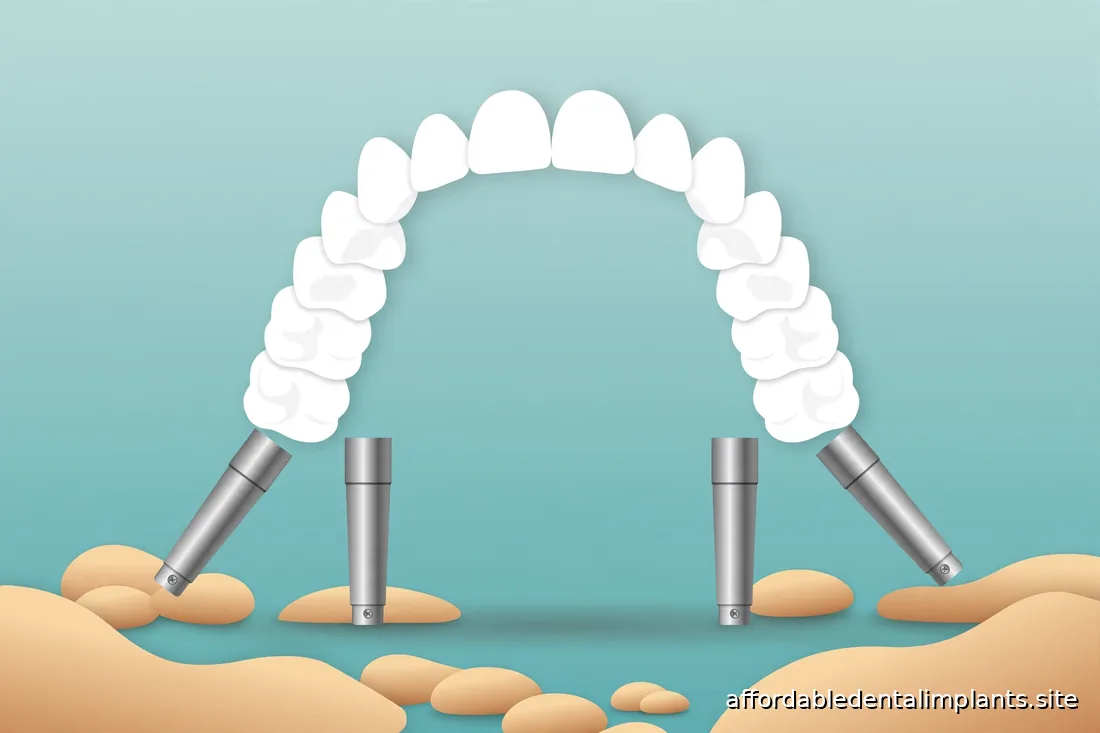
The answer, refined over decades: four. Two implants go straight into the front of the jaw, where bone is naturally denser. Two go into the back — but angled, tilted to anchor into available bone while dodging the sinus cavity (upper jaw) or the nerve canal (lower jaw). That angling is the whole trick: it lets the system use the bone you already have instead of building new bone first.
A rigid bridge — the full arch of teeth — is then fixed onto those four implants. Because the bridge connects everything into one unit, chewing forces distribute across all four posts rather than concentrating on one. It’s the same principle as a table: four well-placed legs carry more than you’d expect.
The practical consequences of that engineering:
- Often no bone grafting. Where individual implants frequently need grafts ($300–$3,000) after bone loss, All-on-4’s angled placement works around thin areas. Less grafting means lower cost and months saved.
- Often no sinus lift. The angled upper implants avoid the sinus floor that complicates standard molar implants ($1,500–$5,000 saved, when applicable).
- Immediate temporaries. Because four implants in dense front bone achieve good initial stability, most patients get a fixed temporary bridge on surgery day — the famous “teeth in a day.”
- Fewer components, lower lab cost. One bridge per arch instead of 10–14 individual crowns is simply less manufacturing.
None of this makes it simple or risk-free — it’s still implant surgery, and the “4” is a minimum, not a magic number. But it explains why All-on-4 costs roughly half of individual-implant full mouths while delivering fixed teeth.
Step by Step: What Actually Happens
Step 1 — Consultation and 3D planning (1–2 visits). Exam, medical history, and a CBCT 3D scan mapping your bone, sinuses, and nerves in three dimensions. The team plans exact implant positions digitally — including the angles — before anything happens. You should leave with a written, itemized treatment plan. Many centers apply the consult fee toward treatment.
Step 2 — Surgery day (one long appointment). Under local anesthesia plus sedation (IV sedation is standard for full-arch surgery; confirm what’s included in your quote), any remaining failing teeth are extracted, the four implants are placed, and — in most cases — a fixed temporary bridge is attached before you leave. Expect several hours in the chair and a few days of swelling and a soft diet.
Step 3 — Healing: osseointegration (3–6 months). You wear the temporaries while bone fuses to the implants. Check-up visits monitor healing; these should be included in the quoted price. You’ll eat carefully — the temporaries are functional but not the final product.
Step 4 — Final impressions and try-in (1–2 visits). Once integration is confirmed, digital scans or impressions capture the healed positions. You’ll typically try in the framework or a mock-up to verify bite, speech, and appearance before the final is made.
Step 5 — Final prosthesis delivery. The lab-crafted final bridge — acrylic hybrid or zirconia — is fixed onto the implants. Bite adjustments follow over the next visits until everything feels right.
Total calendar time: typically 4–8 months without major grafting. Our procedure timeline guide covers the healing phases and what can extend them.
Cost Bands
Published 2026 US pricing for All-on-4:
| Configuration | Typical range | Notes |
|---|---|---|
| All-on-4, one arch | $15,000–$30,000 | 4 implants + temporary + final bridge |
| All-on-4, both arches | $28,000–$55,000 | Upper + lower |
| Bundled centers (per arch) | $20,000–$35,000 | All-inclusive: surgery, temps, finals, imaging, sedation |
| Bundled centers (both arches) | $40,000–$70,000 | One team, one price |
Ranges from 2026 published cost data; bundled-center figures reflect all-inclusive full-arch providers. (dental-area.com; redentklinik.com)
What moves you within the band: final material (zirconia finals run ~30–50% more than acrylic — see our full-mouth cost guide), extractions and any grafting still needed, sedation level, and geography. Also confirm whether the quote includes both the temporaries and the final prosthesis — a quote with only temporaries is half a quote.
The bundled-center premium (roughly $5,000+ per arch over independent clinics) buys a single accountable team and no separate bills. For some patients that’s worth it; for others, an independent prosthodontist + oral surgeon team delivers the same clinical result for less. Get both kinds of quotes before deciding.

All-on-4 vs All-on-6 (and More)
You’ll see All-on-6, All-on-8, and “full arch” quoted with varying implant counts. Here’s how to think about it:
- All-on-4 is the standard protocol — the most studied, the most cost-effective, sufficient for most patients with adequate front-bone.
- All-on-6 adds two implants for redundancy and better load distribution. Each additional implant adds roughly $1,000–$2,500. It’s sometimes recommended for softer bone, heavier bites, or longer arches — and sometimes recommended because it bills more. Ask why the extra implants are needed in your specific case; “stronger” without a clinical reason tied to your scan isn’t an answer.
- More than 6 is unusual for a standard arch and should come with a clear justification.
The uncomfortable truth: implant count is a weak proxy for quality. Four perfectly positioned implants outperform six poorly angled ones. What matters is the planning (CBCT-guided placement), the bone they engage, and the prosthetic design connecting them. When comparing clinics, ask about their planning protocol and their implant survival data — not just how many posts you get.
Also note the naming chaos: “All-on-4” is a Nobel Biocare trademark that’s become generic shorthand for any four-implant full-arch technique. Your clinic’s “All-on-4” may use a different implant brand entirely. That’s fine — but the brand should be named in your treatment plan.
Who It Suits — and Who It Doesn’t
Strong candidates: patients missing most or all teeth in an arch, or with remaining teeth too compromised to save; denture wearers wanting fixed teeth; patients with moderate bone loss who want to avoid extensive grafting; people who can commit to the months-long process and the maintenance afterward.
Weaker candidates / needs extra evaluation:
- Severe bone loss in the front of the jaw. All-on-4 depends on dense anterior bone. If even the front is severely resorbed, grafting or zygomatic implants (longer implants anchored in the cheekbone) may enter the picture — different surgery, different pricing.
- Uncontrolled diabetes or heavy smoking. Both impair healing and raise failure risk for any implant surgery. This doesn’t automatically disqualify anyone, but it’s a serious conversation to have with the surgical team first. (General information — your dentist assesses your individual situation.)
- Very young patients. Full-arch implant bridges are long-term commitments; younger patients should discuss decades-long maintenance plans explicitly.
- Patients expecting zero maintenance. Fixed doesn’t mean forgettable. Full-arch bridges need professional cleanings, daily hygiene around the implants, and eventual prosthesis maintenance or replacement. Anyone selling “permanent teeth, no upkeep” is selling.
How long does it last? The implants themselves: a 2019 systematic review estimated 10-year implant survival at 96.4%. (PubMed) The bridge wears faster — acrylic hybrids may need significant maintenance or replacement within 10–15 years; zirconia lasts longer but costs more upfront. Ask every provider for their expected prosthesis lifespan and replacement cost, not just the implant survival stats.
Frequently Asked Questions
Is “teeth in a day” really one day?
Surgery day, yes — most patients leave with fixed temporary teeth. But the final teeth arrive months later. The phrase describes the surgery appointment, not the treatment. Any honest quote distinguishes temporaries from finals.
Does All-on-4 hurt?
Surgery is done under sedation plus local anesthesia, so the procedure itself isn’t felt. Expect swelling, bruising, and soreness for several days — most patients manage with prescribed or over-the-counter pain relief and a soft diet. (General information; your surgical team will tell you what to expect.)
Can I get All-on-4 if I wear dentures now?
Usually yes — in fact, denture wearers are among the most common All-on-4 patients. The existing bone situation determines whether grafting can be avoided, which the CBCT scan reveals. Our implants vs. dentures comparison covers the trade-offs.
What if one of the four implants fails?
This is the right question to ask before surgery. Protocols vary: some designs tolerate an implant loss with the bridge still supported; others require placing a replacement implant and remaking components. Ask: “What exactly happens, clinically and financially, if an implant doesn’t integrate?” Get it in writing.
Will it look natural?
A well-designed final bridge should look like natural teeth — shade-matched, properly proportioned, with a natural gum line. This is where lab quality and the try-in appointment matter enormously. Ask to see photos of the lab’s actual full-arch work (not stock images), and take the try-in appointment seriously: speak, smile, and look critically before approving the final.
Your next step: If All-on-4 is on your shortlist, get itemized quotes from at least two providers — ideally one bundled center and one independent team — and compare them with our quote-comparison checklist. At $15,000–$30,000 per arch, the second opinion is the cheapest part of the treatment.
This is general information, not medical advice — talk to your dentist about your situation. Prices are 2026 US national estimates from published sources.