Full Mouth Dental Implants Cost: Per-Arch and Both Arches
Full mouth dental implants in the US typically cost $28,000 to $55,000 for both arches using the All-on-4 approach in 2026, or $50,000 to $90,000+ if every tooth gets its own individual implant. Per arch, expect $15,000–$30,000 for All-on-4. The two biggest levers on your quote are the approach you choose and the material of the final teeth — zirconia restorations typically cost 30–50% more than acrylic ones.
“Full mouth” is doing a lot of work in that sentence, because it describes at least four different treatments. This guide lays them side by side — same mouth, different engineering — then digs into material premiums and how payment actually unfolds across a months-long treatment.
Key takeaways
- All-on-4 both arches: $28,000–$55,000; individual implants for every tooth: $50,000–$90,000+.
- Per-arch All-on-4: $15,000–$30,000; premium bundled centers run higher.
- Zirconia final teeth cost roughly 30–50% more than acrylic — but need fewer repairs.
- Full-mouth treatment is paid in stages over months, not all at once — and that staging creates legitimate savings opportunities.
The Four Approaches, Compared
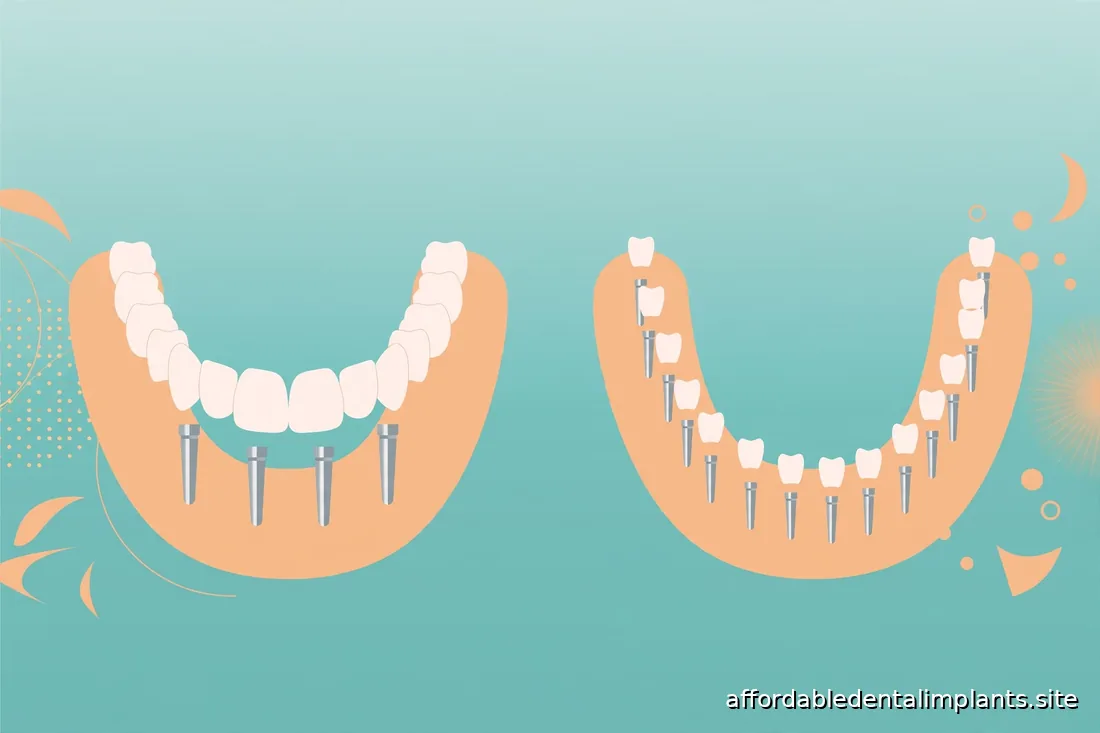
“Full mouth implants” can mean any of these. They’re not upgrades of each other; they’re different engineering answers to the same problem.
| Approach | Implants | Per arch | Both arches | Best for |
|---|---|---|---|---|
| All-on-4 | 4 per arch (sometimes 5–6) | $15,000–$30,000 | $28,000–$55,000 | Most full-arch patients; best value for fixed teeth |
| All-on-6 / All-on-8 | 6–8 per arch | $20,000–$40,000 | $40,000–$70,000+ | Extra stability needs, heavier bite forces |
| Implant overdenture (“snap-on”) | 2–4 per arch | $8,000–$18,000 | $16,000–$36,000 | Budget option; removable for cleaning |
| Individual implants | 8–12+ total, one per tooth | n/a (priced per tooth) | $50,000–$90,000+ | Maximum individual-tooth feel; highest cost |
Ranges from 2026 published US cost data. (dental-area.com) The overdenture — a denture that snaps onto implants — deserves emphasis: at roughly half the price of fixed All-on-4, it’s the option budget-focused patients most often overlook. Our snap-on dentures cost guide covers it in detail.
All-on-4 is the workhorse: four implants per arch (two straight in front, two angled in back to avoid the sinus and nerve), supporting a full fixed bridge. It’s the most cost-effective way to get non-removable teeth because it uses the fewest implants. Many patients leave surgery day with temporary teeth.
All-on-6/8 adds implants for redundancy and load distribution. Each additional implant adds roughly $1,000–$2,500 to the total. It’s sometimes recommended for patients with softer bone or very strong bite forces — but “more implants” isn’t automatically better; placement quality matters more than count.
Individual implants — one post per missing tooth — are the premium route: the most surgery, the most components, the most lab work. The per-tooth economics roughly track single-implant pricing ($3,000–$6,500 each), which is how you arrive at $50,000–$90,000 for a full mouth.
Bundled centers like ClearChoice quote all-inclusive packages — surgery, temporaries, final teeth, imaging, sedation, follow-ups under one price — typically $20,000–$35,000 per arch for full-arch treatment, or $40,000–$70,000 for both arches. The premium over independent clinics buys convenience and predictability: one team, one price, no separate bills. Whether that’s worth it depends on how much you value not coordinating the pieces yourself. (redentklinik.com)
For a plain-English explanation of the All-on-4 system itself — the surgery, the timeline, the trade-offs — see All-on-4 dental implants explained.
Material Cost Deltas: Acrylic vs Zirconia vs Porcelain
Once the implants are in, the teeth you actually wear — the prosthesis — come in different materials, and this choice is one of the two biggest price drivers in full-arch treatment (the other being one arch vs. two).
Acrylic hybrid is the entry point for fixed full-arch teeth. Acrylic teeth on a supportive framework: lighter, easier to adjust and repair chairside, and the most affordable. The trade-off is wear — acrylic can chip, wear down, and absorb stains from coffee, tea, and tobacco over the years, eventually needing refinishing or replacement of teeth.
Zirconia is the premium option: a milled ceramic, extremely strong, highly stain-resistant, with a smooth surface that’s easier to keep clean. The trade-off, beyond price, is repairability — a damaged zirconia arch usually can’t be patched; it often needs a whole new prosthesis. Fractures are rare with good design, but the asymmetry is worth knowing.
The price delta: zirconia final restorations typically cost 30–50% more than acrylic hybrids for the same arch. In dollar terms, that commonly means several thousand dollars extra per arch — one 2026 analysis puts the premium in the low-to-mid five figures per arch depending on the clinic. (dental-implants-tampa-fl.com)
Here’s the honest long-view math most clinics won’t volunteer: acrylic’s lower sticker price comes with maintenance — periodic refinishing, occasional chip repairs, eventual tooth replacement — while zirconia mostly needs standard brushing and checkups. Over 10–15 years the total cost of ownership narrows, though zirconia still usually costs more overall. Neither material is “maintenance-free,” and both demand daily cleaning and professional checkups to protect the gums around the implants. (dental-implants-tampa-fl.com)
Can you start with acrylic and upgrade later? Yes — many patients do exactly this, treating acrylic as a long-term temporary while budgeting for zirconia. But upgrading means fabricating an entirely new prosthesis, so discuss the plan upfront to make sure your implant positions support both options. (dental-implants-tampa-fl.com)

The Payment Timeline: When Money Actually Changes Hands
Full-mouth treatment takes months, and billing follows the treatment phases — which is good news, because it means you rarely pay the whole number at once. A typical staged timeline looks like this:
Phase 1 — Consultation and planning (month 0). Exam, CBCT scan, treatment plan. Often $0–$500; many full-arch centers apply the consult fee toward treatment. This is when you should receive the written, itemized total — not a per-visit drip of surprises.
Phase 2 — Surgery (months 1–2). Extractions (if needed), implant placement, temporary teeth. This is typically the largest single payment — often 40–60% of the total — because it covers the surgical team, sedation, and the temporaries you’ll wear for months.
Phase 3 — Healing (months 2–6). Osseointegration: bone fusing to the implants. You’ll have check-up visits, usually included. Little or no new billing here — which is why the staged structure helps cash flow.
Phase 4 — Final prosthesis (months 4–8). Impressions or digital scans, try-ins, and delivery of the final arch. The remaining balance — commonly 30–50% — comes due here, since the lab-fabricated final teeth are the other big cost block.
That staging creates two legitimate savings plays:
- Split across benefit years. Schedule surgery late in one calendar year and the final prosthesis early in the next, and you can draw on two years of dental insurance maximums (typically $1,000–$2,000 per year). Confirm your plan’s rules first — some have waiting periods for major work.
- HSA/FSA funds. Full-arch costs are HSA/FSA-eligible, and paying with pre-tax dollars effectively discounts the total by your tax rate. Our HSA/FSA guide walks through contribution limits and timing.
Financing is near-universal at this price point: in-house plans, medical credit cards with promotional 0% periods, and multi-year healthcare loans. Get the total cost of the financing — not just the monthly payment — in writing, and compare it against a cash-pay discount, which commonly runs 5–20%. (dental-area.com) Our financing guide compares the options head to head.
What Moves Your Number Within the Range
Two patients getting “All-on-4, both arches” can still land $15,000 apart. The usual reasons:
- Extractions and grafting. Removing failing teeth and rebuilding bone before placement is common in full-mouth cases and adds thousands — but it’s also the step that makes the implants last.
- Sedation level. Local anesthesia is typically included; IV sedation adds $500–$2,000 per surgical session.
- Temporaries vs. immediate finals. Same-day temporary teeth are standard in All-on-4; the final prosthesis months later is a separate lab cost. Make sure both are in the quote.
- Brand and lab. Premium implant systems and US-based labs cost more than economy components and offshore labs. Ask which you’re getting — it’s a fair question at these prices.
- Geography. Same procedure, different zip code: the metro-vs-rural spread that applies to single implants applies here too, scaled up.
And the red-flag version: any full-arch quote dramatically below $15,000 per arch in the US should be itemized with extreme care. Below-cost full-arch advertising usually means the temporaries, the final prosthesis, sedation, or follow-up care are billed separately — or the “arch” price covers fewer implants than the standard protocol. Our guide to why quotes vary and implant specials fine print show exactly where the gaps hide.
Frequently Asked Questions
Is “teeth in a day” real?
Partially. Many All-on-4 patients do leave surgery day with fixed temporary teeth — that’s the “day” part. The final, lab-crafted prosthesis still comes months later after healing. Any quote should distinguish temporaries from finals.
How long does full-mouth treatment take start to finish?
Typically 4–8 months for All-on-4 without major grafting: planning, surgery day, 3–6 months of healing, then final teeth. Extensive grafting can add 3–6 months upfront. Our procedure timeline maps each phase.
Will I need all my remaining teeth extracted?
Often, yes, for full-arch cases — remaining teeth are frequently too compromised to keep, and the arch is designed as a clean system. But “often” isn’t “always”: get a second opinion before agreeing to extract teeth that feel fine, especially molars that could anchor a partial approach.
Do full-arch implants ever fail?
Implants can fail to integrate, usually early. A 2019 systematic review estimated 10-year implant survival at 96.4% — strong, but not 100%. (PubMed) Ask every clinic: what happens, and what does it cost me, if an implant fails? Get the answer in writing.
Can I do one arch now and the other later?
Yes, and many patients do — it’s also a natural way to split costs across benefit years. Just confirm the treatment plan accounts for bite balance between the new arch and the old one.
Your next step: Price the approach, not the slogan. Get itemized written quotes for at least two approaches (e.g., All-on-4 vs. overdenture) from at least two providers, and run them through our quote-comparison checklist. At these dollar amounts, a second opinion isn’t cautious — it’s profitable.
This is general information, not medical advice — talk to your dentist about your situation. Prices are 2026 US national estimates from published sources.