
Dental Implants vs Dentures: Which Is Worth It?
The honest answer: dentures cost far less up front — one FAIR Health dataset puts a full denture at $1,400–$2,400 before insurance. But dentures don’t stop jawbone loss, typically need replacing every 5–10 years, and change how you eat and speak. Implants cost more today and buy back stability, bone preservation, and decades of not thinking about your teeth.
Key takeaways
- A full denture: $1,400–$2,400 before insurance (FAIR Health data via one Alabama practice, June 2026); needs replacing every 5–10 years.
- Without tooth roots, the jawbone keeps shrinking — research documents up to 50% of ridge width lost within 12 months of tooth loss, then 0.5–1% per year for life.
- Implant wearers in studies bite with up to 300% more force than denture wearers (WebMD).
- Denture teeth under a snap-on denture can last 15–20 years, but the implants anchoring them can last a lifetime (WebMD).
- There is a middle ground — 2–4 implants anchoring a removable denture — that costs a fraction of full implants with much of the stability.
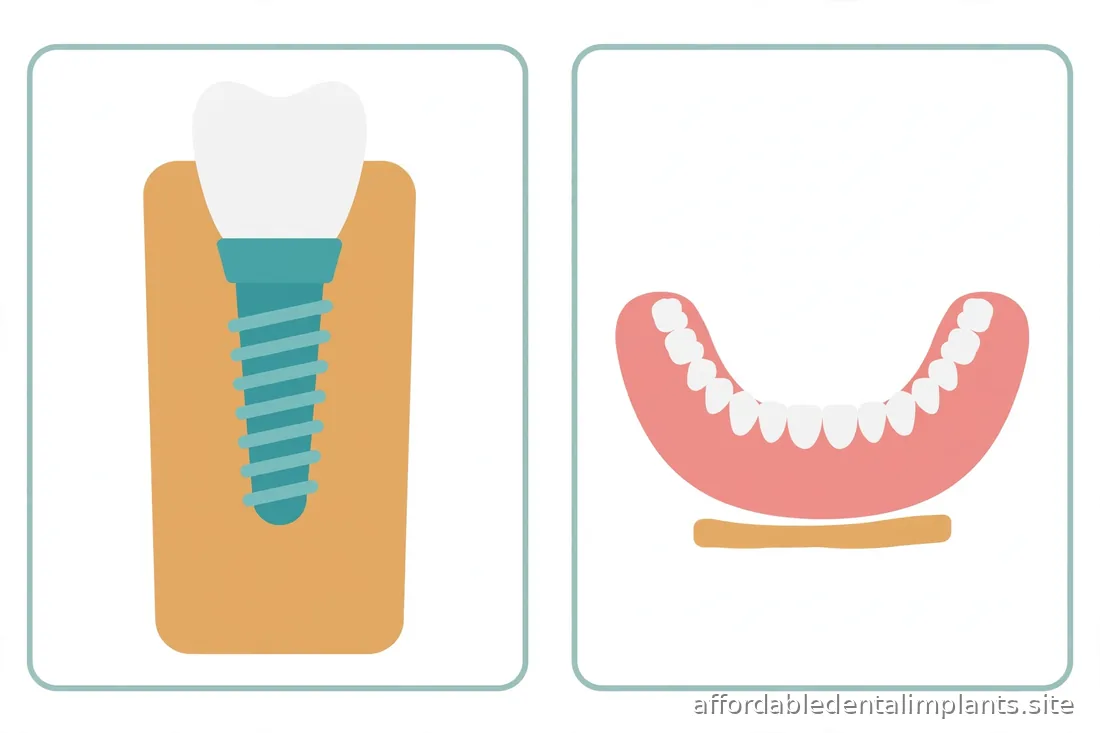
Two different futures for your mouth
This decision is not really about teeth. It is about what happens to your jaw over the next twenty years.
Choose dentures, and you get an affordable, removable appliance that sits on your gums. It looks fine. It works — to a point. But nothing replaces the tooth roots, so the bone underneath keeps dissolving, slowly, for the rest of your life. Every few years the denture fits worse, gets relined or remade, and the cycle repeats.
Choose implants, and you get artificial roots that fuse with the bone and hold it in place. The bill is much bigger up front. But the bone stays, the appliance stays put, and you stop revisiting the same decision every five years.
Most comparison articles lead with price. We are leading with biology, because the biology is what makes the price comparison misleading.
The bone problem, explained plainly
Your jawbone exists to hold tooth roots. Remove the roots and the body starts dismantling the bone — a process called resorption. It is not a theory; it is one of the better-documented phenomena in dentistry.
A peer-reviewed review in the International Journal of Dentistry (via the NIH’s PubMed Central) summarizes the numbers:
- Roughly two-thirds of the hard and soft tissue changes happen in the first 3 months after a tooth is lost.
- About 50% of the ridge width — around 6 millimeters — is lost within 12 months (Schropp et al.).
- Long-term studies report 40–60% shrinkage in height and width within the first 2–3 years.
- After that, resorption continues at 0.5–1.0% per year for life.
Dentures do nothing to stop this. They rest on the gums; they do not stimulate the bone. That is why dentures that fit beautifully in year one feel loose in year four, and why the lower denture is famously the hardest appliance in dentistry to keep stable — the ridge it sits on keeps shrinking underneath it.
Implants are the only replacement option that preserves bone, because only implants replace the root. This is not a marginal benefit. Over decades, it is the difference between a jaw that keeps its shape and one that does not — which shows up in your face, your fit, and eventually your options.
Side-by-side comparison
| Traditional dentures | Full set of implants | |
|---|---|---|
| Upfront cost | Lowest — full denture $1,400–$2,400 before insurance (FAIR Health) | Highest — many times a denture’s cost |
| How it stays in | Suction, gravity, adhesive | Fused to the jawbone |
| Lifespan of the appliance | 5–10 years, then replacement; relines in between | Decades; crowns may need replacement eventually |
| Bone preservation | No — resorption continues | Yes — the only option that does this |
| Chewing power | A fraction of natural bite force | Near-natural; studies show up to 300% more force than dentures for snap-in wearers |
| Daily maintenance | Removed nightly, soaked, brushed; adhesive routine | Brushed like natural teeth |
| Surgery | None (unless extractions needed) | Yes, staged over months |
| Best for | Many/all teeth missing, tight budget, surgery not an option | Long-term function, bone preservation, stability |
The 15-year view
Let us run the math on a full upper-and-lower denture versus a fixed full-arch implant restoration, using published figures where we have them. Your local numbers will differ — treat this as the shape of the curve, not a quote.
Dentures. Say $3,500 for a quality upper-and-lower set (inside the $1,400–$2,400-per-arch FAIR Health range). Replace them at year 7 and year 14. Add relines between replacements — a few hundred dollars each, a couple of times per cycle. Fifteen-year total lands somewhere around $9,000–$12,000, spread across three purchases. And each new set fits a jaw that has less bone than the last one, so satisfaction tends to decline even as spending continues.
Full implants. The up-front bill is large — a full arch of individual implants or an All-on-4-style restoration runs into five figures per arch; see our full-mouth implant cost breakdown for how those numbers are built. Fifteen-year total: mostly that one bill, plus checkups and the occasional crown repair. The appliance does not get remade every seven years. The bone does not shrink away beneath it.
The denture is cheaper in every single year and more expensive in none — until you add up fifteen of them. Whether that matters depends on your time horizon and, frankly, your age. A 75-year-old and a 45-year-old are buying different products even when the brochure is the same.
A day in the life: comfort and stability
Numbers aside, here is what the two options feel like to live with.
Dentures: You take them out every night and soak them. Mornings start with adhesive. Hard foods — apples, steak, crusty bread — become negotiations. They can click when you talk, slip when you laugh, and rub sore spots onto your gums when the fit drifts. Many people adapt and do fine. Many quietly stop wearing the lower one, which accelerates the bone loss the denture was already ignoring.
Implants: You brush them. That is the routine. They do not come out at night, do not need adhesive, and do not move when you eat. Research cited by WebMD found snap-in denture wearers bite with up to 300% more force than traditional denture wearers — and fixed implants do better still, because the load goes straight into the bone.
Snap-on (implant-supported) dentures — the middle ground — get you most of the stability with two to four implants per arch. You still remove them at night for cleaning, but they snap onto the implants and stay put during the day. WebMD notes the implants can last a lifetime while the denture itself needs replacing about every 15–20 years.
Comfort is subjective and we will not pretend otherwise. But there is a reason implant patients rarely go back to dentures, and it is not the brochure.

The middle ground most guides bury
If this article had one job, it would be to make sure you know about snap-on dentures before you decide. Two to four implants anchor a removable denture that snaps into place. It costs a fraction of a full set of individual implants. It preserves bone at the implant sites. It ends the adhesive routine.
It is not perfect — the denture still comes out at night, the attachments wear and need replacing, and with only two implants the denture can still rock slightly. But for the price of one arch of fixed implants, you can often stabilize both arches. For many people, it is the actual answer, and it gets surprisingly little airtime in articles that present the choice as dentures or implants.
Decision guide
Choose traditional dentures when:
- Budget is the deciding factor right now, full stop. A denture today beats a missing-teeth plan that never happens.
- Surgery is off the table for medical reasons.
- You need many teeth replaced quickly — dentures can be made in weeks.
- Your time horizon is shorter and the 15-year math does not move you.
Choose implants when:
- You are missing a few teeth (not all) and want the most natural long-term result. Our piece on how long implants last digs into the longevity data.
- Bone preservation matters to you — and at 45, it should.
- You have worn dentures and know exactly what you are trying to escape.
- You can fund it without wrecking your finances. An implant you cannot afford is not a good deal.
Choose the snap-on middle ground when:
- You want stability and bone preservation at a fraction of full-implant cost.
- You are fine removing the denture nightly.
- Your jaw has enough bone for two to four implants per arch.
FAQs
Can you switch from dentures to implants later?
Yes, and many people do — implants can be placed under an existing denture in some cases, or a new implant-retained denture can be made. The catch is bone: years of denture wear shrink the ridge, and you may need grafting to rebuild what was lost. Switching earlier is easier than switching later.
Do dentures ruin your face shape?
“Ruin” is strong, but the mechanism is real. As the jawbone resorbs, the lower face can lose support and the chin can appear more prominent — the sunken look people associate with long-term denture wear. Implants slow this by preserving bone. It is a slow process measured in years, not months.
Are dentures painful?
Getting dentures should not hurt. Wearing them can cause sore spots, especially as the fit changes — that is what relines are for. Persistent pain means the fit needs attention, not that you need to tough it out.
How do I clean implants versus dentures?
Implants: brush and floss like natural teeth, plus regular professional cleanings. Dentures: removed nightly, brushed with a soft brush and nonabrasive cleanser, soaked in water or solution, and the mouth cleaned too. Snap-on dentures: same as dentures, plus keeping the implant attachments clean.
Will people be able to tell I have dentures?
Modern dentures look far more natural than the stereotype. What gives them away is usually movement — clicking, slipping — rather than appearance. That is another point for anything implant-anchored.
Your next step
This week: ask your dentist two questions. First, “How much usable bone do I have, and is it shrinking?” Second, “What would two to four implants to stabilize a denture cost, itemized?” Most people comparison-shop dentures against full implants and never price the middle option. Price all three. Then decide.
Sources: Rabbit Creek Dental — cost ranges based on FAIR Health Consumer data, Mobile AL, June 2026 · Pagni et al. — Postextraction Alveolar Ridge Preservation (NIH/PMC) · WebMD — Snap-In Dentures: Cost, Care & How They Work
This is general information, not medical advice — talk to your dentist about your situation.