Mini Dental Implants: Cost, Pros, Cons, and Who They’re For
Mini dental implants cost $500 to $1,500 per implant in the US — roughly a third to a fifth of a standard implant’s all-in price. They’re smaller, the procedure is less invasive, and healing takes weeks rather than months. But they are not a cheaper version of the same thing: they’re thinner, generally less durable long-term, and best suited to specific jobs like stabilizing dentures — not as a like-for-like substitute for standard implants under heavy chewing loads.
If a clinic pitches minis as “the same implant, just cheaper,” keep reading. This guide gives minis a fair hearing — they’re a legitimate option for the right patient — while being blunt about where they fall short.
Key takeaways
- Minis cost $500–$1,500 per implant; a denture stabilized with 4 minis often totals $3,000–$6,000.
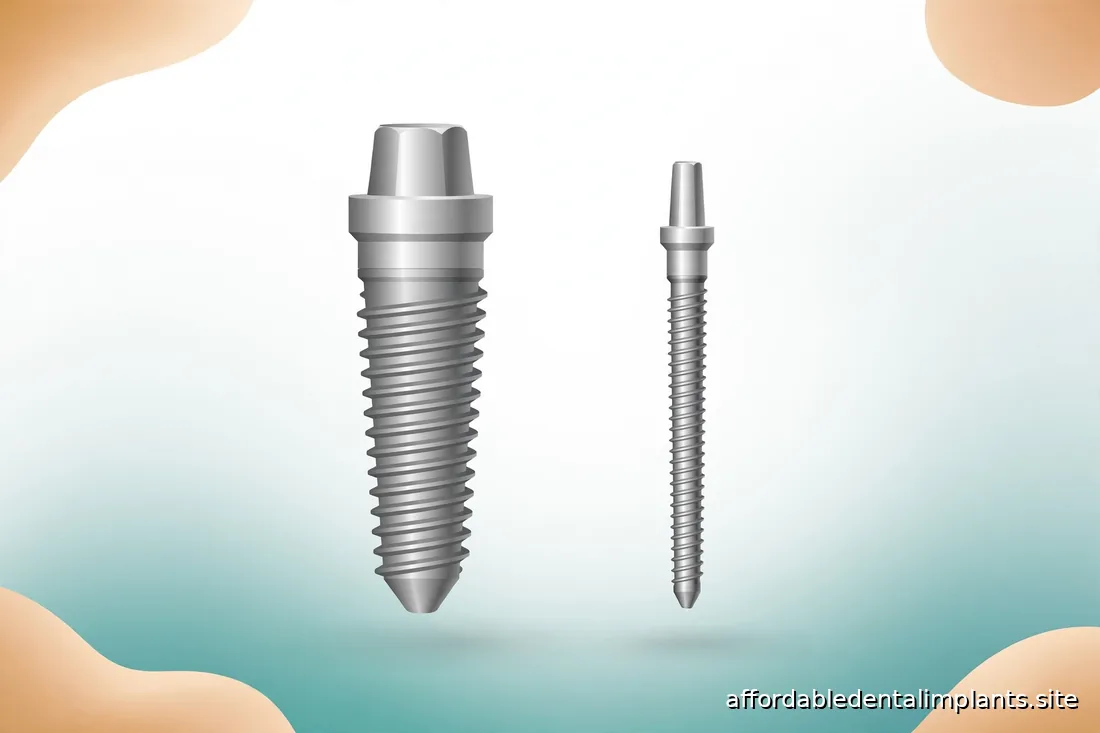
- They’re about half the diameter of standard implants (2–3mm vs 4–6mm) and placed less invasively.
- Typical functional life is often described as 5–10 years — solid, but shorter than standard implants’ decades.
- Best jobs: stabilizing loose dentures, narrow spaces, patients who can’t undergo grafting. Worst job: replacing a molar that takes full chewing force.
What Mini Implants Actually Are (Plain English)
A standard dental implant is a titanium post about 4–6mm in diameter, placed into the jawbone through a surgical procedure, left to fuse with the bone over months, then topped with an abutment and crown. A mini dental implant does the same job description — artificial root anchored in bone — at roughly half the diameter (2–3mm), placed through a much smaller opening, often in a single visit with only local anesthesia. (northside-dentalcare.com)
The smaller size changes the physics. Less surface area gripping the bone means less tolerance for heavy, repeated force. The smaller surgical footprint means less trauma, faster healing, and — critically — no bone grafting in many cases where a standard implant would require it. That’s a genuine advantage, not a marketing line: grafting adds $300–$3,000 and months of waiting to standard treatment, so skipping it is both cheaper and faster. (northside-dentalcare.com)
Minis also differ in design: many are one-piece (post and abutment fused), versus the two-or-three-piece architecture of standard implants. Fewer parts means fewer failure points but also less flexibility — if the angle isn’t perfect, there’s less room to correct it prosthetically.
Where did they come from? Minis were originally designed as temporary anchors — including in orthodontics — and later adapted for permanent use in low-load situations, especially denture stabilization. That origin story matters: they were engineered for specific, lighter-duty jobs, and they excel at those jobs. The controversy only starts when they’re sold as universal replacements for standard implants.
Cost Bands: What Minis Really Cost
The headline number is straightforward: $500–$1,500 per mini implant, depending on the case and region. That’s the implant itself; the restoration on top (crown, bridge, or denture attachment) adds to the total. (northside-dentalcare.com)
What that means in practice for common treatments:
| Treatment | Typical mini-implant cost | Comparable standard-implant cost |
|---|---|---|
| Single tooth (mini + crown) | $1,500–$3,000 | $3,000–$6,500 |
| Two minis stabilizing a partial | $1,500–$3,000+ | $6,000–$10,000+ (bridge on standards) |
| Four minis stabilizing a lower denture | $3,000–$6,000 | $8,000–$18,000 (overdenture on standards) |
| Full-arch mini restoration | $6,000–$12,000 per arch | $15,000–$30,000 (All-on-4) |
Mini figures reflect the $500–$1,500 per-implant band plus restorations; standard figures from 2026 published US data. (northside-dentalcare.com; dental-area.com)
Two cost notes that matter. First, minis often need no grafting and no sinus lift, which removes the $300–$5,000 in preparatory work that inflates many standard-implant quotes — the savings are bigger than the per-implant price gap suggests. Second, the shorter lifespan (below) means you may pay twice: a mini restoration replaced after 8 years can approach the lifetime cost of a standard implant done once. Always do the per-year math, not just the day-one math.
Pros and Cons, Side by Side
| Mini implants | Standard implants | |
|---|---|---|
| Cost per implant | $500–$1,500 | $3,000–$6,500 all-in per tooth |
| Surgery | Less invasive, often single visit, local anesthesia | More invasive, sometimes staged over months |
| Healing | A couple of weeks typically | Several months for full bone fusion |
| Bone requirement | Less — often no graft needed | More — grafting common after bone loss |
| Typical functional life | Often described as 5–10 years | Decades; 96.4% 10-year survival in a 2019 review |
| Load tolerance | Lower — best for lighter forces | Higher — handles molar chewing forces |
| Best uses | Denture stabilization, narrow spaces, front teeth | Single molars, full-arch fixed bridges |
| Repairability | One-piece design less flexible | Modular parts can be serviced individually |
Durability figures: the 5–10 year typical range for minis comes from a dental practice’s published FAQ; the 96.4% 10-year survival for standard implants from a peer-reviewed systematic review. (northside-dentalcare.com; PubMed)
The honest summary: minis trade longevity and load capacity for lower cost, less surgery, and faster recovery. That’s a good trade for some patients and a bad one for others — which is exactly what the next two sections sort out.

Who They’re Actually For
Minis make the most sense when the job fits their engineering. Strong candidates include:
- Denture wearers with loose lower dentures. This is the classic mini-implant success story: 2–4 minis with snap attachments can transform a floating denture into a stable one, often in one visit, for a few thousand dollars. Lower dentures are notoriously hard to keep in place, and minis solve the exact problem at the exact price point. Compare with our snap-on dentures cost guide.
- Patients who can’t — or won’t — undergo grafting. If bone volume is low and you don’t want (or can’t have) months of graft healing, minis’ smaller footprint may work where standards can’t. This includes many older patients and those with medical constraints on surgery.
- Narrow spaces. Lower front teeth and tight gaps where a 4–6mm post physically won’t fit. Minis were partly designed for this.
- Front teeth in low-force situations. Incisors take less chewing load than molars, so the reduced strength matters less — though aesthetics still demand a good crown.
- Budget-constrained patients who understand the trade-off. A mini restoration now, with eyes open about a likely replacement in 5–10 years, can be a rational choice — especially for older patients where a 10-year solution may be a lifetime solution.
Age deserves a direct word: for a healthy 45-year-old, a 5–10 year mini versus a 25+ year standard implant is a very different value equation than for an 80-year-old. Neither answer is wrong; the time horizon is part of the candidacy.
When to Choose Traditional Implants Instead
Be skeptical of minis — or at least ask harder questions — in these situations:
- Replacing molars. Back teeth absorb the heaviest bite forces in the mouth. This is the highest-load job in dentistry, and it’s exactly where minis’ thinner diameter is most limiting. A molar is the worst place to economize on implant strength.
- You grind or clench your teeth. Bruxism multiplies forces on implants. Standard-diameter posts handle it better; minis under a grinder’s load are a known risk combination. (Mention grinding to your dentist before any implant decision.)
- You’re young and want a decades-long solution. If you’re 40, a restoration you’ll likely replace at 50 — then again at 60 — needs to be compared honestly against one implant done once. Do the lifetime math.
- Full-arch fixed bridges. All-on-4-style restorations rely on each implant carrying significant load. Standard protocols use standard implants for a reason; be wary of anyone proposing minis for a full fixed arch without a very clear clinical rationale.
- The quote seems too good to be true. Minis have legitimate uses, but they’re also a convenient vehicle for lowball advertising — “$499 implants!” — that obscures the restoration costs and the longevity trade-off. The same red-flag rules from our quotes-vary guide apply.
The decision framework is simple: match the implant to the load and the timeline. Light load + shorter horizon = minis can be excellent. Heavy load + decades ahead = standard implants are worth the premium. Anything in between deserves a conversation with a dentist who places both — a provider who only offers one type will recommend the one type they offer.
If you’re weighing minis against a conventional denture instead, our implants vs. dentures comparison covers that angle.
Frequently Asked Questions
Do mini implants feel like real teeth?
Largely, yes — they look, feel, and function similarly to natural teeth, with few diet restrictions, and they’re essentially indistinguishable to others. The difference patients notice versus standards isn’t feel; it’s the longevity and load limits underneath. (northside-dentalcare.com)
How long is recovery?
Typically a couple of weeks versus several months for standard implants to fully integrate. Less invasive placement means less post-surgical downtime — one of minis’ genuine advantages. (northside-dentalcare.com)
Can minis support a bridge?
They often work well for bridges and dentures — in fact, multi-tooth restorations spread load across several minis, which suits their design better than single-tooth replacement in some cases. They’re generally less ideal as single-tooth molar replacements. (northside-dentalcare.com)
Will insurance cover mini implants?
Sometimes partially, under the same rules as standard implants — many plans cover the restoration (crown/denture portion) more readily than the surgical post. Verify in writing; “implant” exclusions sometimes apply to minis too.
Can a mini implant be replaced with a standard one later?
Often yes, if bone volume allows — which is worth confirming before choosing minis, not after. Ask your dentist: “If this mini fails in 8 years, is there enough bone for a standard implant, or will I need grafting then?”
Your next step: If you’re considering minis, get two opinions: one from a dentist who places minis regularly, and one from a prosthodontist or oral surgeon who places standard implants. Ask both the same question — “What’s the 10-year plan for this tooth?” — and choose the answer that survives the math.
This is general information, not medical advice — talk to your dentist about your situation. Prices are 2026 US national estimates from published sources.