How Much Do Dental Implants Cost in the US? (2026 Guide)
A single dental implant in the United States typically costs $3,000 to $6,500 in 2026, including the implant post, abutment, and crown. A full-arch restoration (All-on-4) runs $15,000 to $30,000 per arch, and replacing every tooth with individual implants can reach $50,000 to $90,000. Your actual quote depends on what’s included, where you live, and whether you need preparatory work like bone grafting.
That 40-word answer is the honest national picture, based on 2026 published cost data. But a national average is a blunt instrument. This guide breaks the price into its components, shows what different procedures actually cost, and explains the seven factors that move a quote up or down — so you can read any estimate like an insider.
Key takeaways
- Budget $3,000–$6,500 for one complete single-tooth implant (post + abutment + crown).
- The quote is a bundle of parts: roughly $1,200–$3,000 for the post, $300–$800 for the abutment, $800–$2,500 for the crown.
- Add-ons (extraction, grafting, scans, sedation) are where most surprise bills come from — always ask what’s excluded.
- Quotes for the same procedure can vary 50–100% between practices in the same city.
2026 Cost Table: Every Common Procedure
The table below reflects published 2026 US national ranges for complete treatment — meaning the implant, the abutment, and the final tooth or teeth, not just the surgical post. Ranges are wide because geography, provider type, and case complexity move prices substantially.
| Procedure | What’s included | Typical US range (2026) |
|---|---|---|
| Single tooth implant | 1 post + abutment + crown | $3,000–$6,500 |
| Implant-supported bridge (3–4 teeth) | 2 implants + connected crowns | $6,000–$15,000 |
| Implant overdenture (per arch) | 2–4 implants + snap-on denture | $8,000–$18,000 |
| All-on-4 full arch (per arch) | 4–6 implants + fixed arch | $15,000–$30,000 |
| All-on-4 both arches | Full upper + lower | $28,000–$55,000 |
| Full mouth, individual implants | 8+ implants, one per tooth | $50,000–$90,000 |
| Mini implant (per implant) | Smaller-diameter post | $500–$1,500 |
These bands come from a 2026 national cost breakdown that aggregates clinic pricing across the US. At the extremes, a single implant in Manhattan can run $5,000–$8,000, while the same treatment in the rural Midwest or South may land at $2,500–$4,500. (dental-area.com)
Notice what the table does not do: it doesn’t tell you what’s bundled into any particular quote. That’s where the real confusion lives.
What’s Inside a Dental Implant Quote
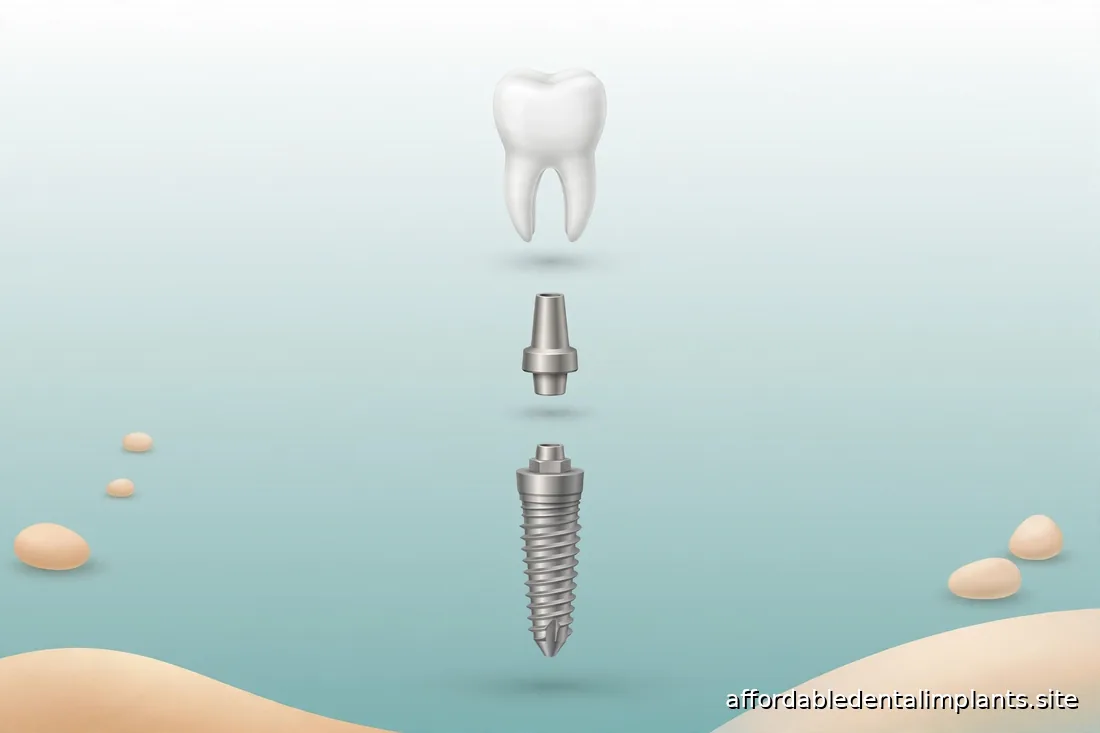
An implant isn’t one product with one price. It’s a small construction project with three main components and a list of possible add-ons. Here’s what each piece typically costs on its own, using 2026 national estimates:
The three core components
- Implant post (fixture) — the titanium or zirconia screw placed in the jawbone. Titanium posts typically run $1,200–$3,000; zirconia posts $1,800–$3,500. This is the most technically demanding part of the job, and the fixture itself costs the practice roughly $200–$500 wholesale depending on the brand. (dental-area.com)
- Abutment — the connector between post and crown. $300–$800, with custom-milled abutments at the top of the range. (dental-area.com)
- Crown — the visible tooth. $800–$2,500 for porcelain or zirconia, depending on material and lab. (dental-area.com)
Add those up and you get $2,300–$6,300 for the implant itself with no extras — which tracks the headline single-tooth range of $3,000–$6,500. One dental practice’s 2026 pricing lands in the same place: $1,500–$2,000 for placement surgery, $300–$500 for the abutment, and $1,000–$2,000 for the crown, for a $3,000–$5,000 all-in total. (advancedsmile.dental)
The add-ons that change everything
Most quotes that look surprisingly low — or surprisingly high — differ in these:
- Tooth extraction: $150–$650 per tooth
- Bone grafting: $300–$3,000 depending on type and extent
- Sinus lift (upper back teeth): $1,500–$5,000 per side
- CBCT 3D scan: $200–$600
- Sedation: $350–$2,000
- Temporary crown during healing: $200–$600
All figures from the same 2026 breakdown. (dental-area.com) With extraction plus a graft, a single-tooth total can climb toward $9,000 at the high end — while a straightforward case with no extras sits near the bottom of the range. This is why two patients can both get “one implant” and pay wildly different amounts.
For a deeper look at how these line items stack up for exactly one tooth, see our single-tooth implant cost breakdown.
The 7 Price Drivers, Explained
If quotes feel random, they aren’t. They follow these seven factors, roughly in order of impact.
1. What’s included in the quote (scope). The single biggest variable. Some quotes cover everything from scan to final crown; others price the post alone and bill the abutment, crown, and follow-ups separately. A “$1,999 implant” that excludes the $1,500 crown is a $3,500 implant wearing a costume. Always get the all-in number in writing.
2. Geography. Implants in major metros cost 20–40% more than in suburban or rural areas. Published 2026 city ranges: New York City $5,000–$8,000 per single implant, San Francisco $4,500–$7,500, Los Angeles $4,000–$7,000, Chicago $3,500–$6,500, Dallas/Houston $3,000–$5,500, Atlanta $3,000–$5,000, and the rural Midwest/South $2,500–$4,500. (dental-area.com; advancedsmile.dental)
3. Provider type. A general dentist with implant training may charge $3,000–$4,000 for a straightforward single implant; an oral surgeon or periodontist typically charges $4,000–$6,000+ for the same procedure. Specialists bring deeper surgical training — relevant for complex cases, less decisive for simple ones. (advancedsmile.dental)
4. Implant brand. Premium systems (Straumann, Nobel Biocare, Dentsply Sirona) cost more because of decades of clinical research, proprietary surfaces, and warranty programs. Economy brands cost less and may have thinner long-term data — not necessarily unsafe, but worth asking about. (dental-area.com)
5. Preparatory procedures. Bone loss is common when a tooth has been missing for a year or more, and grafting adds $300–$3,000. Upper molars may need a sinus lift at $1,500–$5,000. These are medical necessities, not upsells — but they should be itemized, not buried.
6. Prosthetic material. For single teeth, all-zirconia crowns run higher than porcelain-fused-to-metal. For full arches, the material choice is one of the two biggest price drivers: zirconia final restorations typically cost 30–50% more than acrylic hybrids, trading higher upfront cost for better stain resistance and fewer repairs. (dental-implants-tampa-fl.com)
7. Technology and sedation. Guided surgery (3D-planned placement) and in-house CBCT improve precision but add overhead. IV sedation adds $300–$2,000 depending on the case. Local anesthesia is typically included in the base price. (dental-area.com)
How to Compare Quotes Without Getting Burned
Here’s the uncomfortable truth that explains most quote shock: prices for the same procedure can vary by 50–100% between practices in the same city. That’s published 2026 data, not a guess. (dental-area.com) So comparison isn’t optional — it’s the highest-value step in the whole process.
Do this:
- Get at least three quotes, ideally from a mix: a general dentist with implant experience, a periodontist or oral surgeon, and one more of either. Compare more than the total — compare the implant brand, crown material, and exactly what’s included.
- Demand itemization. Ask for every component on its own line: consult, imaging, extraction, graft, post, abutment, crown, temporaries, sedation, follow-ups. If a clinic won’t itemize, that’s information too.
- Ask the “what if it fails” question. What happens — and what does it cost you — if the implant doesn’t integrate? Policies differ enormously.
- Ask about cash pricing. Many practices offer 5–20% discounts for payment in full, since it saves them insurance paperwork and financing costs. It never hurts to ask. (dental-area.com)
- Split the timeline if it helps. Some patients schedule surgery in one benefit year and the crown in the next to use two years of insurance maximums. Not every plan allows it — check yours.
We’ve built a full worksheet for this: how to compare dental implant quotes walks through 12 questions to ask every clinic, plus a worked example of two real-looking quotes side by side.
One more honest note on value: implants have the highest upfront cost of any tooth replacement, but a well-placed implant from a qualified provider can last 25 years or more — often a lifetime — which changes the per-year math considerably versus bridges or dentures that need periodic replacement. (dental-area.com) A 2019 systematic review in the Journal of Dentistry estimated 10-year implant survival at 96.4%. (PubMed)
Frequently Asked Questions
Why is there such a big range — $3,000 to $6,500 — for one tooth?
Because “one implant” describes different scopes. A straightforward premolar with no grafting sits near $3,000; a molar needing extraction, graft, and sinus lift can approach $6,500+. Geography and provider type add the rest of the spread. The range isn’t noise — it’s information about what’s included.
Does dental insurance cover implants?
Often partially. About 78% of dental PPO plans now cover implants at roughly 50%, subject to deductibles, waiting periods (commonly 6–12 months for major work), and annual maximums of $1,000–$2,000. (dental-area.com) Many plans cover the crown more readily than the surgical post. Our dental insurance guide covers the fine print.
What’s the cheapest legitimate way to get an implant?
Accredited dental schools perform implant placement at roughly 50–70% below private-practice rates, with advanced residents supervised by faculty. The trade-off is longer appointments and extended timelines. (dental-area.com) There are 72 accredited dental schools in the US. Discount plans and HSA/FSA pre-tax dollars can stack further savings.
Are “$399 implant” ads real?
The $399 (or $999) figure is typically the implant post alone — not the abutment, crown, imaging, or surgery. Be especially cautious of any complete single implant (post + abutment + crown) priced below about $1,500 in the US; that’s well under material and lab costs. (dental-area.com; advancedsmile.dental)
Can I finance implants?
Yes. In-office payment plans (sometimes interest-free), medical credit cards with 0% promotional periods, and personal loans are all common. A $3,500 implant on a 24-month plan typically runs $80–$150/month depending on terms. (advancedsmile.dental) See dental implant financing options for a detailed comparison.
Your next step: Before you book anything, read our quote-comparison checklist and get three itemized estimates. An hour of comparison shopping is routinely worth $1,000–$3,000 on a single implant — the best hourly rate you’ll ever earn.
This is general information, not medical advice — talk to your dentist about your situation. Prices are 2026 US national estimates from published sources and will vary by location and provider.