
Snap-On (Implant-Supported) Dentures: The Middle Path
Snap-on dentures — dentures that clip onto two to four dental implants per arch — are the compromise option most cost guides skip. Published sources put them at roughly $3,000–$12,000 per arch before insurance, with dental schools charging far less. They end the adhesive-and-slipping routine of traditional dentures at a fraction of the cost of fixed full-arch implants.
Key takeaways
- Snap-on dentures need just 2–4 implants per arch to anchor a full removable denture (WebMD).
- Cost range: $3,000–$12,000 per arch before insurance (WebMD); a Temple University department chair cites ~$2,800 at dental-school pricing versus $11,000+ in faculty practice.
- You still remove them nightly — but they stay put all day, with bite force up to 300% greater than traditional dentures.
- The denture itself needs replacing about every 15–20 years; the small snap attachments wear out and get replaced in between.
- Two implants is the budget entry point; four buys noticeably more stability.
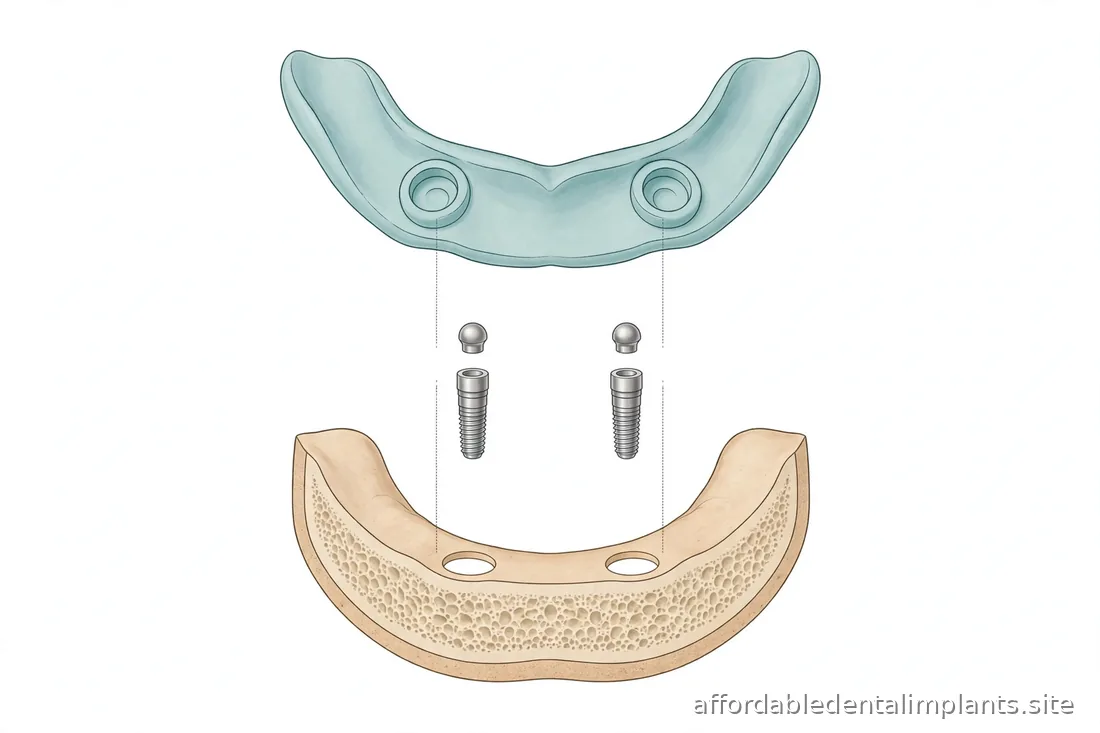
What “snap-on” actually means
Forget the marketing language. Here is the mechanics.
Your surgeon places two to four small titanium implants in your jaw — usually in the front of the lower jaw, where the bone is densest. After a few months of healing, while bone grows around the posts, you wear a temporary denture. Then your dentist fits small connector pieces onto the implants and builds matching sockets into your denture. The denture presses down and snaps onto the implants. It stays put while you eat, talk, and laugh. At night, you pop it out, clean it, and soak it like a regular denture.
“Once it is placed in the jaw, bone grows around the implant to hold it in place. It acts like an artificial tooth root,” says ADA spokesperson Edmond Hewlett, DMD, quoted by WebMD. The implants do two jobs at once: they hold the denture still, and they preserve the bone around them — the one thing traditional dentures cannot do.
The whole concept exists because lower dentures are notoriously miserable. Upper dentures get suction from the palate; lower dentures sit on a shrinking ridge with your tongue fighting them. Two implants in the lower jaw fix the single worst denture problem in dentistry. That is why the classic snap-on case is the lower arch.
The two attachment systems
You will hear two terms. Here is what they mean in plain English:
Locator (stud) attachments. Small individual snap connectors on each implant — like press-studs on clothing. This is the most common and most affordable setup. Simple, easy to clean around, easy to replace when the inserts wear. Most two-implant snap-on dentures use these.
Bar attachments. A slim metal bar joins the implants together, and the denture clips onto the bar. More stable than individual studs, distributes chewing forces better, costs more, and needs more space and more meticulous cleaning underneath. Usually paired with four implants.
Neither is “better” in the abstract. Studs are the budget-friendly workhorse; bars are the upgrade for people who want maximum stability and can keep the bar clean. Your dentist will recommend based on your bone, your bite, and how much maintenance discipline you realistically have.
What snap-on dentures cost
The honest range, from sources we verified:
- $3,000–$12,000 per arch before insurance, per WebMD — the spread reflects location, implant count, materials, imaging, and whether you need bone grafts.
- ~$2,800 for two implants plus the overdenture at dental-school pricing, versus over $11,000 in a university faculty practice, per Aaron Segal, DDS, chair of restorative dentistry at Temple University (quoted by WebMD). That single comparison tells you how much the setting matters.
- Costs climb with each implant added, with bar attachments over studs, and with any grafting.
What the range usually includes: the implants, the abutments/connectors, the denture itself, and processing the attachments into the denture. What it often does not include: the CT scan, extractions, bone grafts, temporaries, and the sedation — ask for those as line items.
Insurance is a mixed bag. As WebMD notes, some plans cover the denture but not the implants holding it in place; others cover both. Get the breakdown in writing before surgery, not after. For a fuller picture of how to fund this, see our comparison of dental implant financing options, and note that mini implants are sometimes used as a lower-cost anchor for snap-on dentures — with their own trade-offs.
Snap-on vs traditional dentures
| Traditional denture | Snap-on denture | |
|---|---|---|
| Stays in via | Suction, gravity, adhesive | Implants it snaps onto |
| Moves while eating/talking | Often, especially the lower | Rarely — “unlikely to detach accidentally” (WebMD) |
| Bite force | Baseline | Up to 300% more, per research cited by WebMD |
| Gum irritation | Common as fit drifts | Less — it does not rub the gums as much |
| Bone preservation | None — resorption continues | At the implant sites, yes |
| Nightly routine | Remove, soak | Remove, soak — same |
| Denture lifespan | 5–10 years | 15–20 years (the implants themselves can last a lifetime) |
| Cost | Lowest | Several times a traditional denture |
The daily experience gap is bigger than the table suggests. Adhesive is gone. The lower denture stops floating. Foods that were negotiations become food again. People who switch consistently describe it as the moment dentures stopped running their lives.

Snap-on vs fixed full implants
This is the comparison for people who can almost afford fixed implants but flinch at the number.
Fixed full-arch implants (All-on-4 style or individual implants with a fixed bridge) do not come out. Only your dentist removes them. They need more implants — eight or more per arch for individual crowns, typically four to six for a fixed full-arch bridge — and the bill reflects it: often two to four times a snap-on case. Our full comparison of implants versus traditional dentures covers the fixed route in detail.
Snap-on gives you implant-anchored stability at a fraction of the price, with easier hygiene (you take the denture out and clean everything properly — no threading floss under a fixed bridge at midnight) and cheaper repairs (a worn denture gets remade; a damaged fixed bridge is a bigger production).
What you give up: the fixed option feels more like natural teeth because it never leaves your mouth, and it preserves bone across the whole arch rather than just at two to four points. If budget allows and you want the closest thing to real teeth, fixed wins. If you want most of the day-to-day benefit — a denture that stays put when you chew and talk — at a fraction of the full-arch fixed cost, snap-on is the value play of modern dentistry.
Maintenance realities nobody mentions
Snap-on dentures are lower-maintenance than traditional dentures, not no-maintenance. Here is what ownership actually involves:
The snap inserts wear out. The little nylon or rubber inserts inside the denture that grip the implants loosen over time — typically every 1–2 years depending on how often you snap in and out. Replacing them is a quick, inexpensive chairside visit, not a crisis. But it is a recurring appointment most quotes do not mention.
The denture itself lasts 15–20 years (WebMD), roughly double a traditional denture — then it gets remade and fitted to the same implants. Budget for that second denture from day one; it is part of the lifetime cost, not a surprise.
The implants need checkups. Implants can develop peri-implantitis — inflammation and bone loss around the post, the implant equivalent of gum disease. Keep your cleaning appointments. Smoking and poor hygiene raise the risk substantially.
Fit changes still happen. The implants hold the denture steady, but the gum tissue and bone between the implants still change slowly over the years. Relines are less frequent than with traditional dentures, but they are not zero.
If one implant fails, a two-implant denture becomes unstable immediately — there is no redundancy. That is the strongest argument for four implants if your bone and budget allow. With four, one failure is a repair; with two, it is an emergency.
Who they’re best and worst for
Best for: lower-denture wearers who hate the floating; people who want implant benefits without fixed-implant prices; patients with enough bone in the front of the jaw for two to four implants; anyone who is fine with a nightly removal routine.
Worst for: people who cannot have oral surgery or anesthesia; severe bone loss that grafting cannot reasonably fix; anyone who will not come back for maintenance — an unmaintained snap-on denture with worn inserts is just an expensive loose denture; people who want “permanent teeth” and will resent taking them out at night.
Your dentist can tell you which group you are in from a scan and an exam. The bone question is the whole ballgame — everything else is preference and budget.
FAQs
How many implants do I need for snap-on dentures?
Two is the minimum and the classic budget option, usually in the lower jaw. Four gives meaningfully more stability and redundancy. WebMD notes the standard range is two to four; fixed (non-removable) dentures need eight or more.
Can my existing denture be converted to snap-on?
Sometimes. If your current denture is in good shape and has enough thickness to house the attachments, a dentist can retrofit it — which saves the cost of a new denture. Ask specifically about retrofitting when you get quotes.
Do snap-on dentures feel like real teeth?
Closer than traditional dentures, not identical to fixed implants. They do not move, which is the big win, but you still feel a denture — a removable appliance with a palate or ridge coverage — rather than individual teeth.
Can I sleep in them?
You should not. Like all removable dentures, they come out at night so the gum tissue recovers. WebMD’s guidance: remove nightly, store in water so they do not warp.
What happens if I need a bone graft first?
Then the timeline extends by months and the cost rises. Grafting is common in the upper jaw and in long-term denture wearers whose ridges have shrunk. It is worth doing — implants placed in inadequate bone fail — but get it as a separate line item on the quote.
Your next step
This week: call two offices — a private practice and your nearest dental school clinic — and ask each for the itemized cost of a two-implant lower snap-on denture, including imaging and the first year of insert replacements. The gap between those two quotes will tell you more about your options than any article can.
Sources: WebMD — Snap-In Dentures: Cost, Care & How They Work
This is general information, not medical advice — talk to your dentist about your situation.