Single Tooth Implant Cost: What You’ll Actually Pay
Replacing one tooth with a dental implant typically costs $3,000 to $5,000 all-in in the US in 2026 — covering the implant post, the abutment, and the final crown. Molars run higher at $3,500–$6,000 because they take more force and sometimes need extra procedures. If you still need the tooth extracted or lack enough jawbone, add $200–$3,000 for those preparatory steps.
That’s the short version. The long version matters more, because “single tooth implant” is sold as one thing and billed as five or six. This article takes one tooth apart line by line, shows how front teeth and molars price differently, and walks through three realistic quote scenarios so you can spot what’s actually in the number you’re given.
Key takeaways
- One complete implant = $3,000–$5,000 typical; $3,500–$6,000 for molars.
- The post is roughly half the cost; the crown and abutment make up the rest.
- Extraction, grafting, and scans are the most common “surprise” add-ons — $200–$3,000 extra.
- A quote under ~$1,500 for the complete treatment is below material and lab costs — ask hard questions.
The Line-Item Anatomy of One Implant
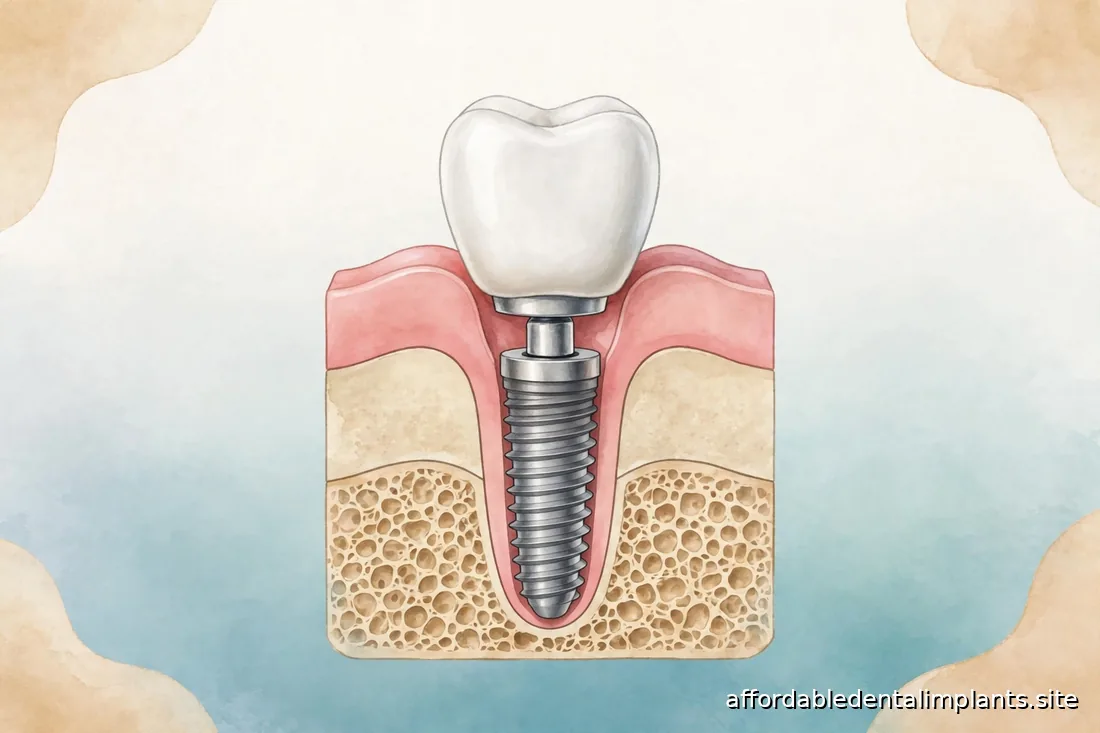
Think of a single implant as three parts plus optional prep work. Published 2026 pricing from US dental practices breaks it down like this:
| Line item | Low | Typical | High | Notes |
|---|---|---|---|---|
| Consultation | $0 | $100 | $200 | Often credited toward treatment |
| Implant placement surgery | $1,500 | $1,750 | $2,000 | Includes post + local anesthesia |
| Abutment | $300 | $400 | $500 | Custom abutments run $500–$800 |
| Crown (porcelain/zirconia) | $1,000 | $1,500 | $2,000 | All-zirconia at the top end |
| Core total | $3,000 | ~$4,000 | $5,000 | Post + abutment + crown |
These bands come from a dental practice’s published 2026 national averages. (advancedsmile.dental) A second 2026 breakdown lands in the same neighborhood with slightly wider bands — post $1,200–$3,000, abutment $300–$800, crown $800–$2,500 — reflecting premium brands and high-cost cities. (dental-area.com)
Now the part most quotes gloss over — the add-ons:
| Possible add-on | Range | When it applies |
|---|---|---|
| 3D CBCT scan | $150–$500 | Surgical planning (very common) |
| Tooth extraction | $75–$650 | Damaged tooth still present |
| Bone graft | $200–$3,000 | Jawbone too thin after tooth loss |
| Sinus lift | $1,500–$3,000 | Upper back teeth near sinus |
| Temporary crown | $300–$500 | Worn during the healing months |
| IV sedation | $300–$700 | Anxiety or complex cases |
Add-on figures from the same 2026 sources. (advancedsmile.dental; dental-area.com)
Here’s the practical insight: the core procedure is fairly standardized in price; the add-ons are where quotes diverge. Two clinics can charge nearly identical fees for the post, abutment, and crown — and hand you totals $2,000 apart — because one included a graft and scan and the other didn’t mention them yet.
Front Tooth vs Molar: Why Position Changes the Price
Not all single teeth are priced equally. Where the tooth sits in your mouth changes the materials, the difficulty, and the likelihood of extra procedures.
Front teeth (incisors, canines): $3,000–$5,000. The challenge here is aesthetics. A front crown has to match your natural teeth in color and translucency, which usually means an all-ceramic or zirconia crown at $1,200–$2,000. Placement can also be technically trickier because the bone in the upper front region is often thinner, raising the chance of needing a graft. (advancedsmile.dental)
Molars (back teeth): $3,500–$6,000. Molars take the heaviest chewing forces, so they need wider, stronger posts and larger crowns with more lab material. Upper back molars sit near the sinus, which can require a sinus lift. Surgery in dense back-jaw bone also takes longer. (advancedsmile.dental)
| Factor | Front tooth | Molar |
|---|---|---|
| Typical total | $3,000–$5,000 | $3,500–$6,000 |
| Crown priority | Appearance (all-ceramic/zirconia) | Strength (zirconia/PFM) |
| Crown cost | $1,200–$2,000 | $1,000–$2,000 |
| Graft likelihood | Moderate — thin front bone | Lower, but bone is denser |
| Sinus lift risk | Possible (upper front) | Possible (upper molars) |
| Main cost driver | Aesthetic materials + grafting | Wider post + larger crown + sinus work |
If you’re comparing a bridge instead — which replaces one missing tooth by crowning the two neighbors — our implants vs. bridges comparison runs the 20-year math. Spoiler: the bridge looks cheaper on day one and often isn’t over decades.
Three Quote Scenarios, Decoded
These are illustrative scenarios built from the published component ranges above — not prices from any specific clinic. They show how the same “one implant” becomes three very different totals.
Scenario A: The straightforward premolar — $3,800 all-in
Maria, 52, lost a lower premolar to a cracked root two years ago. The socket healed cleanly, her bone volume is good, and she needs no extraction (the tooth is already gone).
- Consultation + CBCT scan: $250
- Implant placement (titanium post): $1,750
- Stock abutment: $400
- Porcelain-fused-to-metal crown: $1,200
- Follow-up visits: included
- Total: $3,600
This is the best-case single implant: healthy bone, no extras, mid-range materials. Totals like this sit squarely in the published $3,000–$5,000 band. If your mouth looks like Maria’s, quotes much above $4,500 deserve a second opinion — and quotes much below $3,000 deserve scrutiny about what’s excluded.
Scenario B: The molar with baggage — $6,100 all-in
David, 61, needs an upper first molar replaced. The tooth is still there but fractured below the gumline. His dentist’s CBCT shows the sinus floor sitting close to the implant site.
- Consultation + CBCT scan: $350
- Surgical extraction: $400
- Sinus lift: $2,000
- Implant placement (wide-body titanium post): $2,000
- Custom abutment: $600
- Zirconia crown: $1,800
- Total: $7,150 — negotiated down to $6,400 with a 10% cash-pay discount
Nothing here is inflated; every line falls inside published ranges. The sinus lift alone is the difference between Scenario A and B. This is also the scenario where a “cheap” quote is most dangerous: a $2,999 advertised price that omits the extraction and sinus lift isn’t cheaper — it’s incomplete.
Scenario C: The visible front tooth — $5,200 all-in
Priya, 44, lost an upper central incisor in a bike accident. She wants the replacement invisible. The front bone is thin, so a modest graft is needed, and she opts for a premium implant brand and an all-ceramic crown.
- Consultation + CBCT scan: $300
- Minor bone graft: $900
- Implant placement (premium brand): $2,000
- Custom abutment: $650
- All-ceramic crown: $1,850
- Temporary crown during healing: $400
- Total: $6,100 — her dental plan covers the crown portion at 50% up to its $1,500 annual max, bringing her out-of-pocket to roughly $4,600
Note how insurance helped but didn’t transform the math: annual maximums of $1,000–$2,000 cap what plans pay, so even insured patients commonly pay $1,500–$3,000 out of pocket on a single implant. (advancedsmile.dental)

Legitimate Ways to Pay Less
If the numbers above sting, you have real options — none of which involve cutting corners on the implant itself:
- Dental schools. Accredited programs place implants at roughly 40–60% below private practice rates, with advanced students supervised by faculty. Expect longer appointments. (advancedsmile.dental)
- Timing across benefit years. Some patients have the post placed in December and the crown seated in January, using two years of insurance maximums. Check that your plan allows it.
- HSA/FSA dollars. Paying with pre-tax money effectively discounts the cost by your marginal tax rate — often 20–35%. Our HSA/FSA guide explains the rules.
- Financing. CareCredit-style plans commonly run $80–$150/month for a $3,500 implant on a 24-month term; many practices offer 12-month interest-free in-house plans. (advancedsmile.dental)
- Ask for cash pricing. A 5–20% pay-in-full discount is common enough that you should always ask. (dental-area.com)
What not to do: chase the lowest advertised post price without asking what it excludes. “$399 implants” and “$999 implants” ads virtually always price the post alone — the crown and abutment, another $1,300–$2,500, arrive later. (advancedsmile.dental) Our guide to comparing implant quotes gives you the exact questions that expose this.
Frequently Asked Questions
How long does a single implant take from start to finish?
Typically 3–6 months for a standard case: consultation and planning, placement surgery, a healing period while the bone fuses to the post (osseointegration), then the abutment and crown. Add 3–6 months if grafting is needed first. Our step-by-step procedure timeline maps every visit.
Does it hurt?
With local anesthesia, placement surgery itself is generally described as less uncomfortable than a tooth extraction. Post-surgical soreness for a few days is normal and usually managed with over-the-counter pain relief. (This is general information — your dentist can tell you what to expect for your case.)
Will insurance cover a single implant?
Partially, sometimes. Many plans cover about 50% of “major restorative” work after a 6–12 month waiting period, capped by a $1,000–$2,000 annual maximum. Some plans cover the crown and abutment but exclude the surgical post; others have a “missing tooth clause” denying teeth lost before the policy started. Verify in writing before treatment.
Can I get just the post now and the crown later to spread the cost?
Often yes — the post and the restoration are separate phases months apart anyway. Some patients deliberately schedule the crown in the next benefit year. Confirm the plan with your dentist so the timing doesn’t compromise healing.
How long will one implant last?
The post itself can last decades: a 2019 systematic review estimated 10-year implant survival at 96.4%. (PubMed) The crown may need replacement after 10–15 years of wear. Longevity depends heavily on gum health, bite forces, and maintenance.
Your next step: Get the component list, not just the total. Ask any clinic quoting you: “Does this include the abutment, the crown, imaging, and follow-up visits — and what would change the price?” Then run their answer through our quote-comparison checklist before you commit.
This is general information, not medical advice — talk to your dentist about your situation. Prices are 2026 US national estimates from published sources.