
Dental Implants vs Bridges: Cost, Longevity, and Trade-offs
If you are missing one tooth, here is the honest summary: a bridge costs less up front and needs no surgery, but it typically lasts 5 to 15 years and permanently reshapes two healthy neighboring teeth. A single-tooth implant costs more today, avoids touching those teeth, and 10-year implant survival runs roughly 96 percent.
Key takeaways
- Bridges last 5–15 years before replacement (WebMD); a 2019 meta-analysis puts 10-year dental implant survival at 96.4%.
- A traditional bridge costs about $1,500–$5,000 without insurance (WebMD); a complete single implant in one FAIR Health dataset ran $4,600–$5,500 before insurance.
- A bridge is really two procedures sold as one: it permanently grinds down the two healthy teeth next to the gap.
- Over 20–30 years, the implant often costs less — because the bridge gets replaced, and each replacement is another bill.
- Choose the bridge when the neighboring teeth already need crowns, or surgery is not advisable. Choose the implant when those teeth are healthy and you want the cheapest per-decade option.
The short answer
A bridge wins the first year. An implant wins the next thirty. That is the whole debate in one sentence.
A bridge is cheaper to buy and faster to get — two or three appointments, no surgery, done within weeks. An implant takes months and costs roughly twice as much up front. But bridges wear out and get replaced, usually every 5 to 15 years. Implants, once fused to the bone, tend to stay. So the question is never really “which is cheaper.” It is “cheaper when?”
The rest of this article walks through the numbers and the one biological cost that never shows up on a quote.
How each option actually works
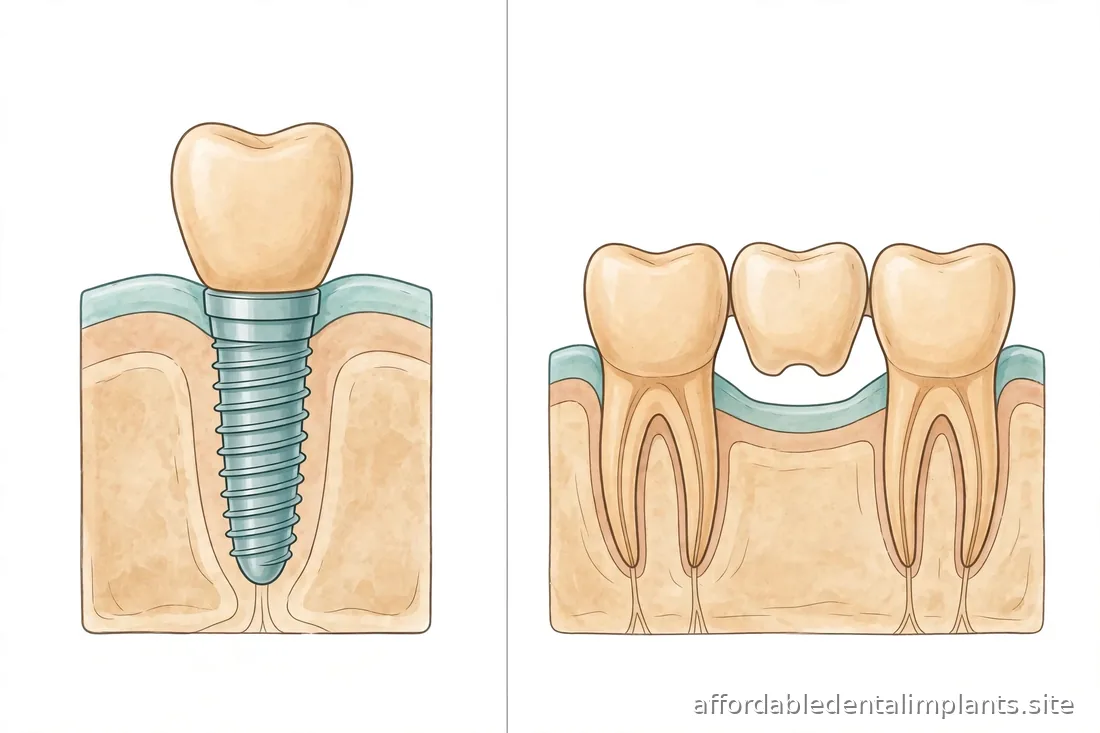
A traditional bridge uses the two teeth on either side of the gap as anchors. Your dentist grinds those teeth down into smaller stumps, fits crowns over them, and hangs a false tooth (called a pontic) between the two crowns. The whole thing is cemented as one fixed unit. Only a dentist can remove it. The procedure usually takes two visits a few weeks apart.
A single-tooth implant replaces the whole tooth, root included. A small titanium post goes into the jawbone where the root used to be. Over several months, bone grows around it (osseointegration). Then a connector and a custom crown go on top. Your neighboring teeth are never touched.
There are also implant-supported bridges, which use implants as the anchors instead of your natural teeth. They cost more — WebMD notes prices can reach $15,000 — but they dodge the healthy-tooth problem entirely.
If the mechanics bore you, skip ahead. What matters is the table below and the cost math after it.
Side-by-side comparison
| Single-tooth implant | Traditional bridge | |
|---|---|---|
| Upfront cost | Higher — FAIR Health data for one metro area showed $4,600–$5,500 complete, before insurance | Lower — $1,500–$5,000 without insurance (WebMD) |
| Typical lifespan | Decades; 96.4% survival at 10 years in a 2019 meta-analysis | 5–15 years (WebMD) |
| Effect on neighboring teeth | None — they are never touched | Permanent — both are ground down for crowns |
| Jawbone under the gap | Preserved — the implant stimulates the bone | Shrinks — bone loss continues without a root |
| Surgery required | Yes, plus months of healing | No |
| Timeline | 3–6+ months | 2–4 weeks |
| Repair if something fails | The crown can usually be replaced without removing the post | Usually means replacing the entire bridge |
| Who it suits | Healthy neighboring teeth; adequate bone | Neighbors already need crowns; surgery not an option |
The 10-year cost picture
Prices are illustrative, built from the sources cited. Your quotes will differ — see our guide to comparing implant quotes item by item for how to read them.
The bridge route. You pay, say, $2,800 for a three-unit bridge (inside WebMD’s $1,500–$5,000 range). Year zero cost: $2,800. If it lasts 10 years, you buy another one in year 10 — and fee inflation means it will not cost $2,800 again. Even without inflation, two bridges in 10 years runs about $5,600. Three in 20 years: roughly $8,400.
The implant route. You pay around $5,000 once (inside the $4,600–$5,500 FAIR Health range for a complete single implant). Year zero cost: $5,000. At year 10, you have spent $5,000 — and the implant itself is still there with 96.4% odds. The crown on top may need replacement at some point, which is a fraction of the full procedure, not a full re-do.
The crossover happens somewhere in the first replacement cycle. After that, the bridge keeps billing you and the implant mostly stops.
One honest caveat: not everyone lives the averages. Some bridges last 20 years with excellent hygiene. Some implants fail early, especially in smokers or people with uncontrolled diabetes. The research figures are population averages, not promises about your mouth.
The trade-off nobody advertises: your two healthy teeth
This is the part of the decision that has nothing to do with money, and it deserves its own section.
To fit a bridge, your dentist must grind down two perfectly healthy teeth. That enamel never grows back. Those teeth now live their lives under crowns, and crowned teeth carry their own risks: decay can start at the margin where the crown meets the tooth, and the stress a bridge puts on the anchor teeth can weaken them. WebMD lists exactly this as the bridge’s main disadvantage — the whole bridge can be damaged by trouble with the surrounding teeth, and those teeth can break under the strain.
If one anchor tooth fails years later, the entire bridge has to be redone — now spanning a bigger gap with one fewer anchor.
There is one scenario where this trade-off disappears: when the neighboring teeth already need crowns anyway. Big old fillings, cracks, previous root canals — if the grinding was going to happen regardless, the bridge’s main downside costs you nothing extra. That is the single strongest case for choosing a bridge, and dentists who are honest with you will say so.
What the research says about longevity
The numbers above are not marketing. They come from specific places:
- Bridges: 5–15 years. WebMD states this plainly, and notes that “permanent” bridges are a misnomer — they wear out and get replaced.
- Implants: ~96% at 10 years. A 2019 systematic review and meta-analysis by Howe and colleagues (published through Elsevier, archived at the University of Liverpool) pooled 18 prospective studies of contemporary implant systems and found a 10-year implant-level survival of 96.4%.
Notice the asymmetry. Bridge lifespan is measured in replacement cycles. Implant survival is measured in the thing is still there. That is the difference between a product and a fixture.
One more asymmetry: when an implant crown wears out, the dentist replaces the crown. The titanium post stays. When a bridge wears out, the whole structure goes. Over decades, that difference in repair granularity matters as much as the headline lifespan.
Decision guide: when each one wins
Choose the bridge when:
- The neighboring teeth already need crowns — the trade-off is free.
- You cannot have oral surgery, for medical or personal reasons.
- You need the gap filled in weeks, not months.
- You are replacing teeth on a limited budget right now and the long game is a problem for later. That is a legitimate choice — just make it with eyes open.
Choose the implant when:
- The neighboring teeth are healthy and you would like them to stay that way.
- You are under 60 and likely to live through two or three bridge replacement cycles.
- You have adequate bone (or can get a graft) and are a candidate for surgery.
- You care about bone preservation under the gap. Bridges and dentures let the jawbone shrink; implants do not.
Choose an implant-supported bridge when:
- You are missing two or three teeth in a row and want the fixed feel of a bridge without sacrificing healthy teeth. It costs the most up front, but it combines the bridge’s multi-tooth coverage with the implant’s independence.
None of this is a diagnosis. It is a framework to bring to the consultation. For a deeper look at why two offices quote different numbers for the same implant, read why implant quotes vary so much. And if the issue is bone volume, our piece on bone grafts and sinus lifts explains the add-on costs honestly.
Questions worth asking your dentist
Bring these to the appointment. The answers tell you a lot about whether the office is selling or advising.
- What condition are my neighboring teeth actually in — do they need crowns regardless?
- Is my bone adequate for an implant, or would I need a graft? What would that add?
- What is your bridge replacement rate — how often do your bridges come back at 10 years?
- If I choose the implant and the crown wears out in 15 years, what does that repair cost versus a new bridge?
- What is the all-in price for each option, including imaging, temporaries, and follow-ups?
FAQs
Can you get an implant later if you get a bridge now?
Often yes, provided the bone under the gap has not shrunk too far and the anchor teeth have not deteriorated. But the anchor teeth have been permanently reshaped either way — that part is not reversible.
Does insurance cover bridges better than implants?
Frequently, yes. Many dental plans cover a portion of bridges while classifying implants as elective or covering them poorly. Coverage varies widely by plan; the procedure choice and the coverage choice are two separate problems. Solve them separately.
Is a bridge painful to get?
The procedure itself is done under anesthesia and should not hurt. The bigger discomfort is philosophical: you will feel your healthy teeth being ground down, and you cannot un-know it afterward. (That is a joke. Mostly.)
What about a Maryland bridge — does it damage teeth less?
A Maryland (resin-bonded) bridge uses metal or porcelain wings bonded to the backs of neighboring teeth, so it requires far less reshaping. It is a reasonable middle option for front teeth, but it is less durable than a traditional bridge and usually not recommended for back teeth, where chewing forces are highest.
Do implants really preserve bone?
Yes — that is the implant’s least debatable advantage. The post transfers chewing forces into the jawbone, which signals the body to maintain it. Bridges and dentures sit above the gumline and provide no such signal. Research on post-extraction bone loss shows the jawbone can shrink dramatically without a root in place, which is one more reason not to leave a gap empty for years.
Your next step
This week: get two itemized quotes — one for the bridge, one for the single implant — from the same dentist, and ask each quote to include imaging, temporaries, and follow-up visits. Then run the 10-year math above on your own numbers. The right answer is the one that survives contact with your actual mouth, your actual bone, and your actual budget.
Sources: WebMD — Dental Health Bridges: Types, Benefits, Care & Cost · Howe et al. 2019 — Long-term (10-year) dental implant survival: systematic review and meta-analysis · Rabbit Creek Dental — cost ranges based on FAIR Health Consumer data, Mobile AL, June 2026
This is general information, not medical advice — talk to your dentist about your situation.