Dental Schools for Implants: How Much Cheaper, and What’s the Catch?
Dental school clinics are the most underused discount in American dentistry. Students and residents treat patients under faculty supervision, and prices reflect the teaching mission: one department chair cites roughly $2,800 for a two-implant overdenture at dental-school pricing versus over $11,000 in that school’s faculty practice. The catch is real — longer appointments, waitlists, and clinics that choose their cases.
Key takeaways
- Dental school pricing can run a fraction of private-practice fees — the Temple University comparison ($2,800 vs. $11,000+) shows the scale of the gap.
- Every step is checked by licensed faculty; students do not freelance on your mouth.
- Expect appointments to take 2–3× longer, scheduling to be rigid, and treatment to stretch over more visits.
- Not every school places implants — and clinics accept cases that fit their teaching needs, not just your needs.
- Find accredited programs through the Commission on Dental Accreditation’s program search (coda.ada.org).
How much cheaper, really
Start with the hardest number we could verify. Aaron Segal, DDS — chair of the Department of Restorative Dentistry at Temple University — is quoted by WebMD stating that two implants plus an overdenture costs approximately $2,800 at dental-school pricing, while the same treatment in his school’s faculty practice (performed by a prosthodontist) runs over $11,000. That is not a 10% student discount. It is roughly a quarter of the price.
How broadly that ratio holds depends on the school, the procedure, and whether students or residents do the work (resident clinics, staffed by licensed dentists in specialty training, typically price between student clinics and faculty practice). Published guides commonly describe school-clinic savings of around half off private-practice fees, with some procedures discounted more. Treat any specific percentage as a starting point for your phone call, not a promise — every school sets its own fee schedule.
What is consistent: for multi-thousand-dollar implant treatment, the dental school quote is almost always the lowest domestic number you will find. If you are comparison shopping, the school clinic is the floor of the market. Get that quote even if you are fairly sure you will not use it — it anchors every other quote you receive. Our complete implant cost guide gives you the private-practice side of the comparison.
Why it’s cheaper (the economics)
The discount is not charity and not a trick. It is the byproduct of how teaching clinics work:
Your treatment is the curriculum. Students need a set number of supervised procedures to graduate; residents need complex cases to complete specialty training. Your implant case is someone’s required competency. The school’s mission is education, and affordable patient care is how it gets the raw material.
Labor costs are near zero. The person doing the work is paying tuition for the privilege. Faculty supervision is salaried, not fee-for-service. The school does not need your case to cover a dentist’s production targets, a practice loan, or a marketing budget.
Overhead is institutional. The building, the equipment, and the sterilization infrastructure exist for teaching regardless. Patient fees offset costs; they do not need to generate profit.
You pay in time instead of money. This is the actual exchange rate, and it is the whole catch: appointments run longer, scheduling follows the academic calendar, and treatment that takes three visits privately may take six. The discount is real because the inconvenience is real.
What to expect as a patient
Walk in with the right expectations and the experience is fine. Walk in expecting a private practice and you will be frustrated by noon.
Screening first. Most schools start with an evaluation appointment to determine whether your case fits their teaching needs. Bring any X-rays or records you have. Be honest about your medical history — it affects case selection.
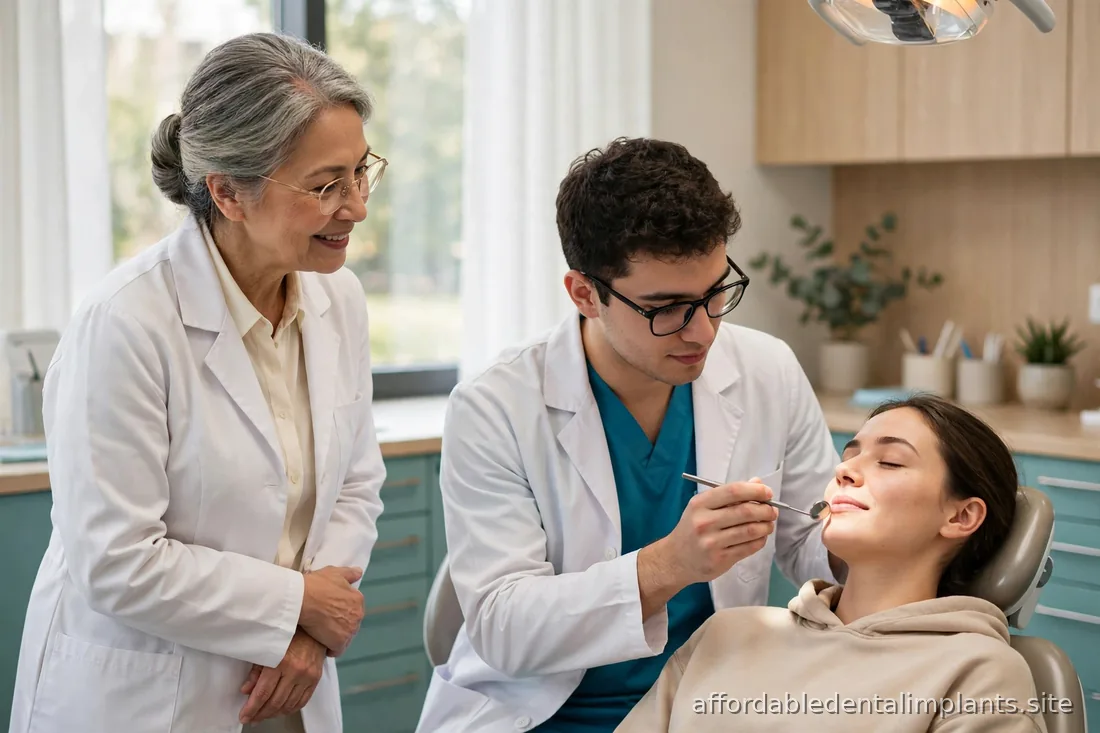
Every step is supervised and checked. This is the part skeptics get wrong. Students do not work alone: a licensed faculty dentist reviews the treatment plan, checks the work at each stage, and is present for critical steps. Implant cases in particular tend to involve residents or faculty directly, because implantology is advanced work that schools do not hand to beginners unsupervised.
Appointments take longer. A procedure that takes an hour privately can take two or three at a school. The student works more slowly (they are learning), and each stage pauses for faculty verification. Plan accordingly — do not schedule a school appointment in a lunch break.
The calendar is the academic calendar. Clinics slow down or close during student breaks. Treatment that spans months — and implant treatment always spans months — needs to be planned around semesters. Ask about this at screening so a summer break does not strand you mid-treatment.
Communication is thorough, sometimes to a fault. Students document everything and explain everything, because explaining is part of being graded. If you like understanding what is happening in your mouth, this is a feature.
Finding an accredited program: the walkthrough
Do not just Google “cheap dental implants near me” — that search is a minefield of lead-generation sites. Use the official channel:
Step 1: Open the Commission on Dental Accreditation’s program search at coda.ada.org/find-a-program/search-dental-programs. CODA is the ADA’s accrediting body — the authoritative list of legitimate programs.
Step 2: Search by program type and location. You are looking for predoctoral dental schools (DDS/DMD programs) with patient clinics, and — for implant work specifically — postgraduate programs in prosthodontics, periodontics, or oral surgery, which handle the most complex cases. Filter by your state.
Step 3: Go to the school’s clinic page directly. Look for “patient care,” “dental clinic,” or “become a patient.” Avoid third-party directories when the school’s own site will do.
Step 4: Call and ask these questions:
– Do you place implants for clinic patients, and is it the student clinic, resident clinic, or faculty practice?
– What is the screening process, and is there a waitlist? How long?
– Can you give a fee range for my specific treatment (extraction + implant + crown, or whatever your plan is)?
– How are appointments scheduled, and what happens during academic breaks?
– Who supervises the work, and what happens if something needs fixing after hours?
Step 5: Compare the quote against two private-practice quotes. The school is your price floor; now you know exactly what the convenience of private practice costs. Sometimes the gap is life-changing. Sometimes it is smaller than expected once you factor in your time — either way, you are deciding with data.
One caution from our scam-spotting guide: any “dental school” advertising primarily on price via aggressive ads, without a verifiable university affiliation and CODA accreditation, is not a dental school. Verify the institution independently.

The limitations, honestly stated
Case selection cuts both ways. Schools accept cases that serve teaching needs. A straightforward single implant may be ideal for a student clinic; a complex full-mouth reconstruction may be reserved for the prosthodontics residency — or declined if it does not fit anyone’s curriculum that semester. You are not just a patient; you are a teaching case, and the school decides if you qualify.
Waitlists are real. The combination of low prices and limited chairs means popular programs have queues. If your tooth is actively failing, the wait may cost you bone — sometimes the right move is a private-practice extraction now and school-clinic implant later.
Emergencies are awkward. If something hurts at 9 PM on a Saturday, a teaching clinic is not your private dentist’s emergency line. Ask at screening what after-hours coverage exists and line up a local dentist for urgent issues.
Continuity varies. Your student graduates. Your resident finishes the program. Handoffs happen and are usually managed well, but your case may change hands mid-treatment in a way private practice rarely does.
Not all schools do implants. Smaller programs may not offer implant placement at all, or only through the faculty practice at near-private rates. The phone call in Step 4 exists to filter these out quickly.
None of these are disqualifiers — they are logistics. For a patient with more time than money, the trade is usually worth it. For a patient with an urgent, complex case and a flexible budget, private practice earns its premium.
FAQs
Are dental school implants safe?
The supervision structure is the safety mechanism: licensed faculty plan and verify the work. Teaching clinics also tend to be conservative — they follow protocols meticulously because protocols are what is being taught. The risk profile differs from private practice (slower, more appointments) rather than being obviously higher.
Will a student or a resident do my implants?
It depends on the case and the school. Straightforward cases may go to advanced students under close supervision; complex implant work usually goes to residents (licensed dentists in specialty training) or faculty. Ask which clinic level your case qualifies for — it affects both price and timeline.
How long does treatment take compared to private practice?
Longer — more appointments, longer appointments, and academic-calendar gaps. A single implant that takes 4–6 months privately might take 6–9 months at a school. If your timeline is flexible, the savings per extra month are usually enormous.
Can I get just part of my treatment at a school?
Sometimes. Some patients get the surgical phase (extraction, implant placement) at a school and the crown at a private office, or vice versa. Coordination takes effort and both providers need to agree — discuss it at screening rather than assuming.
Do schools offer snap-on dentures or just single implants?
Many do — overdenture cases are excellent teaching cases, and the Segal pricing cited above was literally for a two-implant overdenture. Ask specifically; prosthodontics departments are the ones to call. Our snap-on denture guide covers what that treatment involves.
Your next step
This week: run the CODA program search for your state, identify the two nearest dental schools with patient clinics, and make both screening calls using the five questions above. Even if you never become a patient, you will walk away with the two cheapest legitimate quotes in your market — and every decision after that gets easier.
Sources: WebMD — Snap-In Dentures: Cost, Care & How They Work · Commission on Dental Accreditation — Search Dental Programs
This is general information, not medical advice — talk to your dentist about your situation.